Effects of protein interface mutations on protein quality and affinity

Effects of protein interface mutations on protein quality and affinity
de Kanter, J. K.; Smorodina, E.; Minnegalieva, A.; Arts, M.; Blaabjerg, L. M.; Frolenkova, M.; Rawat, P.; Wolfram, L.; Britze, H.; Wilke, Y.; Weissenborn, L.; Lindenburg, L.; Engelhart, E.; McGowan, K. L.; Emerson, R.; Lopez, R.; van Bemmel, J. G.; Demharter, S.; Spreafico, R.; Greiff, V.
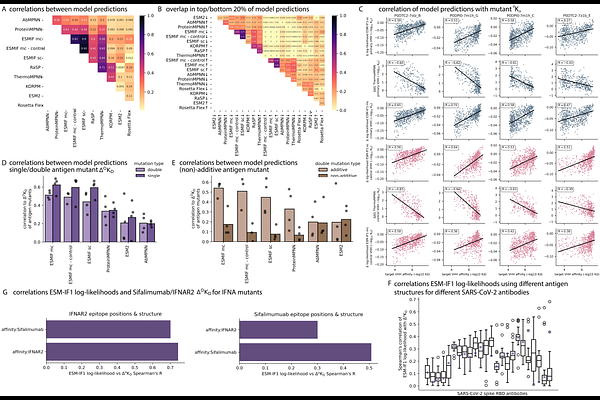
AbstractAccurately modeling antibody-antigen interactions requires distinguishing intrinsic binding affinity ('protein-interaction') from protein biophysical properties ('protein-quality'), including folding, stability, and expression. However, high-throughput mutational measurements commonly used to train and benchmark computational models often conflate these effects, obscuring the true determinants of molecular recognition. Here, we present an experimental and analytical framework to disentangle protein-interaction effects from protein-quality effects in single-domain antibody (VHH)-antigen binding. Using a large-scale deep mutational scanning (DMS) dataset spanning four VHH-antigen complexes, with single and double mutations in both partners, we introduce control binders to quantify protein-quality changes independently of protein-interaction. This enables decomposition of experimentally measured affinity into protein-interaction and protein-quality components at scale. Leveraging the disentangled dataset, we evaluated state-of-the-art structure- and sequence-based models for protein-quality and protein-interaction prediction and show that their performance largely reflects protein-quality rather than protein-interaction effects. Our results highlight a major confounder in current datasets and suggest that accounting for protein-quality will be essential for training next-generation affinity-prediction models.