Digital Kennison: A bioinformatics pipeline for rapid mapping of sequences to the Drosophila melanogaster Y chromosome

Digital Kennison: A bioinformatics pipeline for rapid mapping of sequences to the Drosophila melanogaster Y chromosome
Uno, F.; Carvalho, A. B.
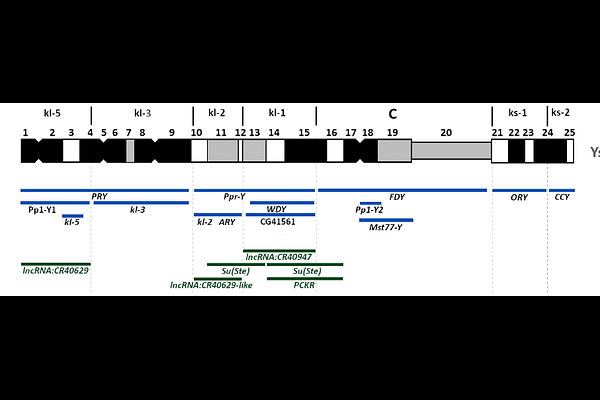
AbstractThe Drosophila melanogaster Y chromosome is currently known to contain 13 single-copy protein-coding genes, six of which are essential for male fertility, as well as several non-coding genes and abundant repetitive DNA. Localization of Y-linked sequences has traditionally relied on labor-intensive crosses using Kennison's translocation strains, which map Y-linked loci by generating flies deficient for each of the six Y-chromosome fertility regions (ks-1, ks-2, kl-1, kl-2, kl-3, and kl-5). Here we present Digital Kennison, a computational pipeline that recasts this classical mapping strategy as a sequence-based analysis. The pipeline queries eight genomic databases derived from Kennison's strains using BLAST and read coverage, assigning sequences to fertility regions with a calibrated confidence score. We benchmarked the method on 60 Y-linked sequences spanning all six regions, including single-copy protein-coding genes, Mst77Y family members, non-coding RNAs, and the centromere. Digital Kennison achieved 97% precision while resolving challenging cases, including boundary-spanning genes (PRY and Ppr-Y), fragmented Mst77Y copies, and FDY, which has a closely related autosomal paralog. Beyond validating known localizations, the pipeline localized the unmapped gene CG41561 to the kl-1region and reassigned the transcript CR40629-RC from the kl-2 region to kl-5. It also localized 7 of 16 recently transferred Y-linked sequences described by Tobler et al. (2017), including 4 with high confidence. Applied to 904 small R6 scaffolds, Digital Kennison assigned 75% to fertility regions, including five currently annotated as autosomal-pericentromeric. Digital Kennison reduces sequence localization from weeks of genetic crosses to minutes of computation while preserving the power of classical translocation mapping.