GRB 240205B: A Reverse Shock Detected in Rapid Response Radio Observations

GRB 240205B: A Reverse Shock Detected in Rapid Response Radio Observations
S. I. Chastain, G. E. Anderson, A. J. van der Horst, L. Rhodes, C. Morley, A. Gulati, J. K. Leung, T. D. Russel, S. D. Ryder
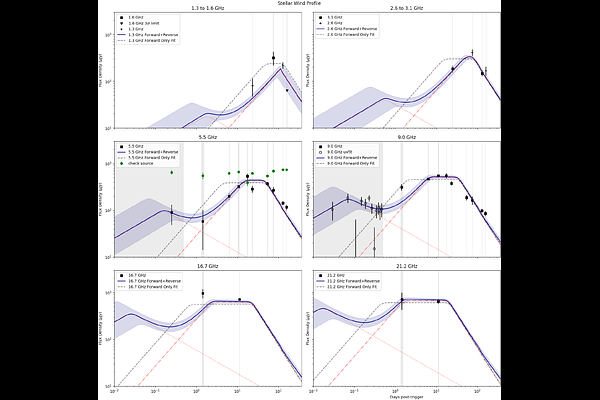
AbstractHere we present broadband radio modeling of GRB 240205B, using observations with the Australia Telescope Compact Array (ATCA) and the South African MeerKAT radio telescope. Our observations include an automatically triggered early-time ATCA observation that began approximately 13 minutes after the gamma-ray signal and continued for 12 hours, resulting in the earliest detected GRB radio afterglow to date at about 35 minutes post-burst. Following this initial detection, we conducted an extensive radio follow-up campaign for more than 5 months. Although the observations beyond one day post-burst are well described by a standard forward shock model, the observation before one day post-bust reveals an additional synchrotron component, which can be explained as the reverse shock. This component would have been missed without the automated ATCA rapid-response trigger. We find that a combined reverse and forward shock model in a stellar wind medium best describes the radio afterglow. We constrain the spectral breaks due to synchrotron self-absorption and the minimum electron energy, and we use the light-curve peaks to constrain the microphysical parameters. We put GRB 240205B in the context of the growing sample of GRBs with radio detections in the first hours after the gamma-ray trigger. Using our rapid response observation, we estimate the highest model independent constraint on a GRB minimum bulk Lorentz factor of around 100 at about 35 minutes post burst. We also discuss future prospects of detecting similar long GRBs at centimeter wavelengths, as well as potential improvements to future strategies for targeting their radio afterglows.