Many-body quantum percolation sustains ohmic proton flux through the nanoconfined Fo motor

Many-body quantum percolation sustains ohmic proton flux through the nanoconfined Fo motor
Adeniran, I.; Lightfoot, A. P.
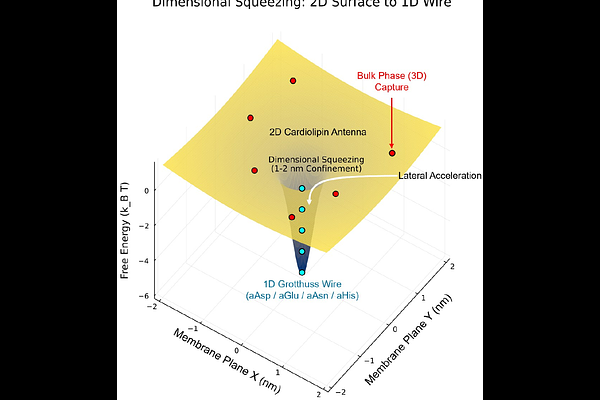
AbstractThe FoF1-ATP synthase drives cellular bioenergetics by translocating protons across the inner mitochondrial membrane. We recently demonstrated that the lipid cardiolipin acts as a 2D antenna, actively funnelling protons into the nanoconfined F_o motor and enforcing severe "dimensional squeezing". This 1D nanoconfinement forces protons into such close proximity that their hydration shells physically overlap, theoretically generating an infinite classical steric gridlock. Yet, empirical measurements show the F_o motor operates at ~90% efficiency and exhibits barrierless, ohmic conductance, presenting a biophysical paradox. To resolve this contradiction between classical physics and biological reality, we employed a differentiable inverse physics framework to blindly deduce the proton wire's geometry based solely on macroscopic physiological constraints: ohmic linearity and a 1.7 Deuterium Kinetic Isotope Effect. By substituting classical diffusion frameworks with a Many-Body Overdamped Quantum Langevin Equation (QLE), the optimiser successfully converged. It deduced that physiological flux dictates a steric boundary of 0.137 nm (aligning with the effective crystal radius of oxygen) and a structural confinement scale of 0.974 nm. We demonstrate that when these discovered biological parameters are evaluated under classical, independent-particle assumptions, the 1/r^12 steric repulsive forces diverge to infinity, causing a simulation collapse. In contrast, the quantum mechanical nature of the QLE allows protons to exist as spatially spread out clouds rather than fixed point particles. This enables them to traverse tight steric boundaries via a coordinated chain reaction similar to a frictionless nanoscale Newton's cradle. These findings prove that classical, independent-particle models are incompatible with the spatial confinement of respiratory complexes. We conclude that physiological proton transport through the Fo motor mandates a continuous quantum percolation channel, redefining our theoretical understanding of biological energy transduction.