Strontium and helium in the kilonova AT2017gfo: Origin of the 1μm feature constrained via NLTE calculations

Strontium and helium in the kilonova AT2017gfo: Origin of the 1μm feature constrained via NLTE calculations
Aayush Arya, Rasmus Damgaard, Albert Sneppen, David J. Dougan, Stuart A. Sim, Connor P. Ballance, Darach Watson
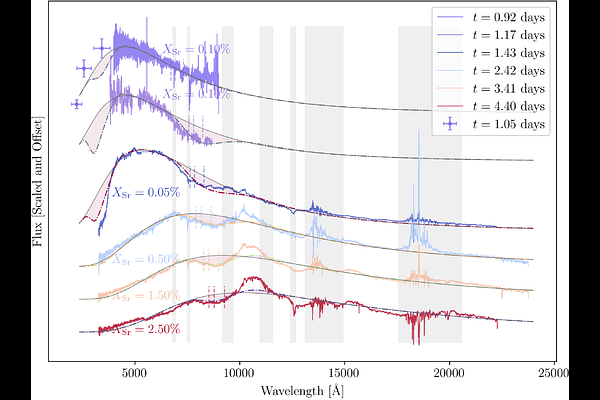
AbstractMergers of neutron stars are believed to be one of the primary sites for the synthesis of the universe's heavy elements via the rapid neutron capture process. AT2017gfo, the kilonova following GW170817 provided the first direct spectroscopic evidence of the $r$-process happening in the universe. A prominent line feature near $1\,μ$m in its spectrum was attributed to strontium -- a claim that has been independently recovered by several teams. However, in recent years it has been debated whether the feature arises instead from helium. Here, we present non--local thermodynamic equilibrium (NLTE) radiative transfer modelling of the observed kilonova spectra, including detailed radiation-matter interaction physics for both strontium and helium. We make use of freshly calculated strontium atomic data for e$^-$ impact collisions, photoionization, and recombination processes. Our strontium model self-consistently reproduces the temporal evolution of the $1\,μ$m feature at early times, with its absence at $0.92\,$days to its clear emergence at $1.17\,$days. This transition mimics LTE, because at early epochs ($t\lesssim 1.5\,$days) the radiation field dominates the ionization state of the ejecta over thermal and non-thermal electron collisions. We further test if helium can form the feature under the same plasma conditions. The helium mass required at $1.17\,$days is comparable to the total ejecta mass, while a few percent by mass of helium suffices at 4.4 days. On the other hand, the strength of the strontium lines decrease with time, and may require a radially stratified abundance to consistently produce the feature. We conclude that strontium is required to explain the onset of the feature at early times, but helium can contribute to, or even dominate the feature at later epochs.