Solid-state NMR Reveals Mobility-Based Organisation of the Schizosaccharomyces pombe Cell Wall

Solid-state NMR Reveals Mobility-Based Organisation of the Schizosaccharomyces pombe Cell Wall
Singh, A.; Massam-Wu, T.; Balasubramanian, M.; Chow, W. Y.
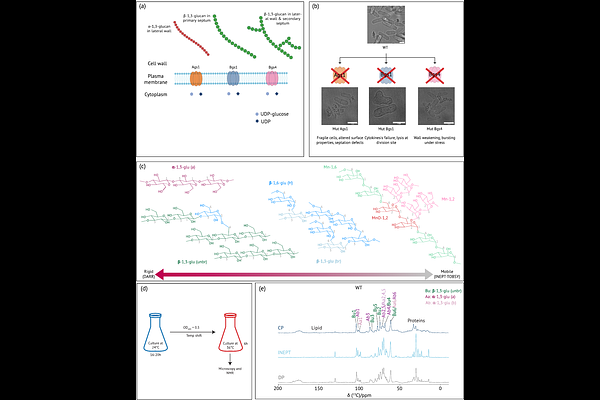
AbstractFungal cell walls are hierarchically organised polysaccharide networks whose mechanical and functional properties depend on both chemical composition and molecular organisation. Although glucan synthases are essential for cell wall biosynthesis, how individual synthases shape the supramolecular architecture and dynamics of intact walls remains poorly understood. Here, we combine mobility-resolved 13C solid-state NMR spectroscopy with targeted genetic perturbation of the glucan synthases Ags1, Bgs1, and Bgs4 to determine how synthase activity governs the molecular organisation of the Schizosaccharomyces pombe cell wall. We first establish a molecular-level reference for the wild-type wall by identifying the major glucan and mannan environments and resolving polysaccharides according to their mobility directly in intact cells. The rigid wall scaffold is dominated by unbranched {beta}-1,3-glucan and -1,3-glucan, whereas branched glucans and mannans occupy more dynamic molecular environments. Comparison with thermosensitive glucan synthase mutants reveals distinct, mutation-dependent reorganisation of both the rigid structural scaffold and the mobile polysaccharide matrix. Quantitative analysis further shows that, despite retaining broadly similar glucan compositions, the Ags1, Bgs1, and Bgs4 mutants redistribute carbohydrates among rigid, intermediate, and mobile molecular environments in distinct ways. These mutation-specific mobility fingerprints demonstrate that glucan synthases regulate not only polysaccharide biosynthesis but also how cell wall polymers are assembled, packed, and dynamically organised within the intact wall. More broadly, our findings establish molecular mobility as a sensitive signature of cell wall architecture that reveals structural consequences of biosynthetic perturbation not apparent from composition alone. Mobility-resolved solid-state NMR therefore provides a powerful framework for linking genetic perturbations to molecular dynamics and supramolecular organisation in intact fungal cell walls.