Combinatorial constraints predict that mitochondrial networks contain a large component

Combinatorial constraints predict that mitochondrial networks contain a large component
Mostov, R.; Lewis, G. R.; Das, M.; Marshall, W. F.
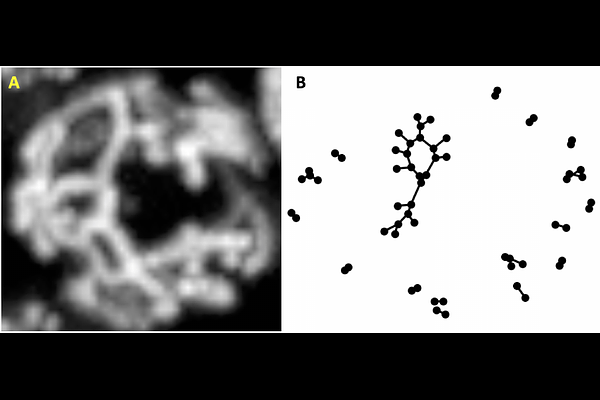
AbstractMitochondria often form branching membrane networks distributed throughout the cell interior. In many, though not all, cell types, these networks are observed to consist of one large connected component together with many smaller fragments. Why does this pattern arise? Does it reflect a specific biological function, an external biophysical constraint, or something simpler? Using results from extremal graph theory, we prove a new theorem which suggests that, under a sufficiently broad sampling of the space of mitochondria-like graphs, the predominance of three-way junctions makes the appearance of a large component likely. This suggests that, in some settings, a large component may serve as a useful null model for mitochondrial network structure rather than requiring a dedicated explanation. More broadly, our result points towards testable predictions, since systematic deviations from this baseline may help reveal additional constraints or mechanisms shaping mitochondrial morphology.