Development of an Ethylenediaminetetraacetic Acid-Enhanced Deep Proteomic Profiling Method for Dried Blood Spots and Its Application in Mouse Disease Models

Development of an Ethylenediaminetetraacetic Acid-Enhanced Deep Proteomic Profiling Method for Dried Blood Spots and Its Application in Mouse Disease Models
Nakajima, D.; Kanno, T.; Okuda, Y.; Mitsui, H.; Konno, R.; Ueyama, N.; Endo, Y.; Ohara, O.; Kawashima, Y.
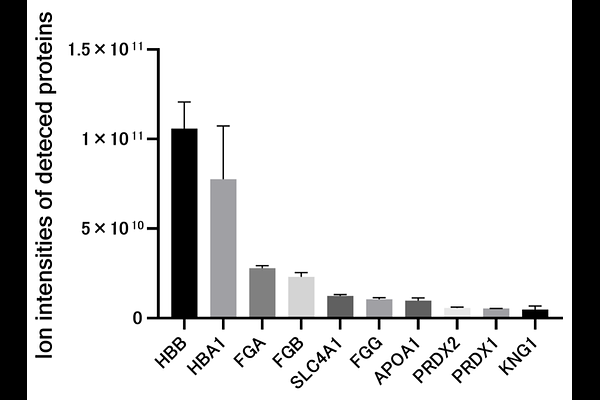
AbstractDried blood spots (DBS) are well-established microsamples used in clinical testing and newborn screening. However, their use in deep proteomics is hindered by highly abundant blood proteins and inefficient protein recovery from filter paper matrices. The non-targeted analysis of non-specifically DBS-absorbed proteins (NANDA) workflow partially overcomes the impact of abundant blood proteins and has enabled the identification of over 5,000 proteins from DBS samples. Nonetheless, residual abundant proteins, including hemoglobin and fibrinogen, constrain deep proteomic analysis. Therefore, this study aimed to evaluate the effects of the metal chelator ethylenediaminetetraacetic acid (EDTA) on the depth of DBS proteomic analysis. An optimized EDTA-enhanced NANDA protocol that incorporated a 100 mM EDTA wash step was compatible with standard DBS collection procedures and required no modification of current clinical workflows, markedly enhancing the depletion of abundant proteins and facilitating its potential use in clinical and translational settings. When combined with Orbitrap Astral data-independent acquisition mass spectrometry, this approach enabled the single-shot identification of more than 7,000 proteins from DBS samples; to the best of our knowledge, this represents the deepest proteome coverage reported to date, and the workflow further supported high-throughput and highly reproducible analyses. Additionally, its application to mouse disease models revealed disease-specific systemic immune signatures from minimal blood volumes. Collectively, these results establish EDTA-enhanced NANDA as a practical and scalable workflow that overcomes longstanding limitations of DBS proteomics, thereby enabling deep, high-throughput, minimally invasive proteomic profiling across diverse biological and experimental contexts.