Modes in Transitional Millisecond Pulsars: Evidence of Pulsar Wind-Induced Disk Heating from GRMHD and Radiative Transfer

Modes in Transitional Millisecond Pulsars: Evidence of Pulsar Wind-Induced Disk Heating from GRMHD and Radiative Transfer
Mignon-Risse Raphaël, Linares Manuel, Parfrey Kyle, Tchekhovskoy Alexander, Ressler Sean
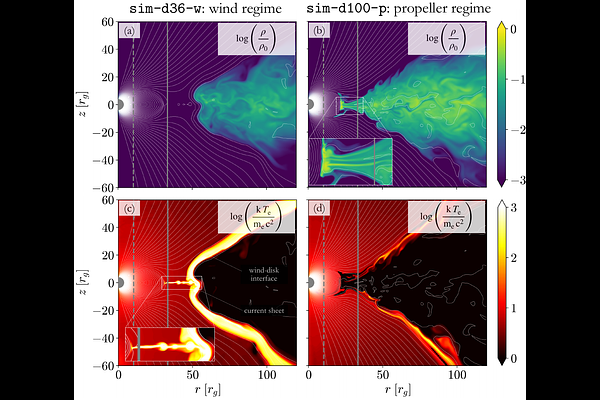
AbstractTransitional millisecond pulsars (tMSPs) alternate between radio and X-ray pulsar states, and can represent the missing link between rotation- and accretion-powered neutron stars. Their disk state switches stochastically between the low and high X-ray modes, both of unknown physical origin and less luminous than low-mass X-ray binaries. To reveal the source of the X-ray emission, we carry out 2D axisymmetric general-relativistic magnetohydrodynamical simulations of the interaction between an accretion disk and tMSP magnetosphere. For the first time, we post-process tMSP simulations with a radiative transfer code that incorporates thermal synchrotron, absorption, and Compton scattering processes. By varying the disk density, hence the inflow rate, we explore two disk regimes: one truncated outside and another inside the light cylinder. In the former, most of the X-ray flux comes from the synchrotron emission powered by the wind heating the disk: this "wind" regime could correspond to the high X-ray mode. The latter is the propeller regime and lacks this heating process. However, the propeller episodically expels the disk, activating the wind heating: a 70%-30% mixture of such propeller and wind regimes reproduces the X-ray spectrum of the low X-ray mode. The excess electromagnetic torque in the propeller regime increases the spin-down rate, averaged over both modes, by a few percent above the disk-free radio pulsar state, in agreement with observations. Overall, the system is more luminous in X-rays when the flow is truncated outside the light cylinder and supports a contribution from wind-induced disk heating in both low and high X-ray modes.