SN 1006: A Cosmic Laboratory for Investigating Shock Acceleration Physics

SN 1006: A Cosmic Laboratory for Investigating Shock Acceleration Physics
Emma McGinness, Rebecca Diesing, Damiano Caprioli, Fabio Acero
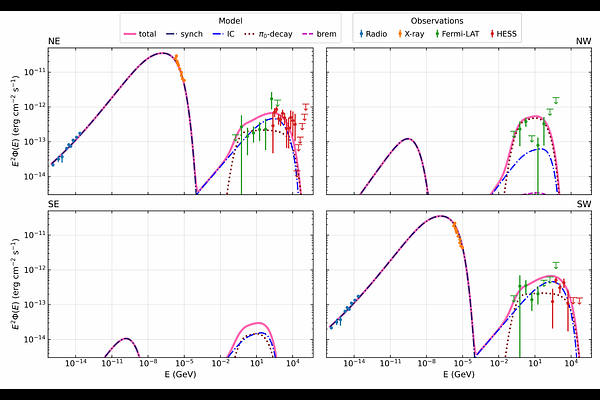
AbstractSN 1006 is a historical Type Ia supernova remnant that exhibits non-thermal emission ranging from radio to multi-TeV $γ$-rays. Most of this emission (particularly X-rays and $γ$-rays) is concentrated in polar caps aligned with the ambient magnetic field, which makes it an ideal laboratory for studying cosmic ray (CR) acceleration at different shock obliquities and the hadronic/leptonic nature of the $γ$-ray emission. We model SN 1006's morphology, multi-wavelength spectrum, and radial profile using a self-consistent multi-zone kinetic model of particle acceleration that accounts for: CR-driven shock modification, magnetic field amplification, drift in magnetic fluctuations, and temporal dynamics including adiabatic and synchrotron losses. Our model can reproduce both the observed spectral and spatial properties, with the exception of the radio profile that we argue requires 3D hydrodynamic effects to replicate. We find that quasi-parallel regions (where the shock normal aligns with the ambient magnetic field) exhibit very prominent CR acceleration ($\sim$20% efficiency), while quasi-perpendicular regions exhibit efficiencies below 1%, consistent with the results of kinetic simulations. We also find that electrons are responsible for the majority of the $γ$-ray emission from SN 1006 (i.e., it is a leptonic source), with the exception of the northwest region due to an encounter with a dense cloud.