The SANE, the MAD, and the Chimera

The SANE, the MAD, and the Chimera
George N. Wong, James M. Stone
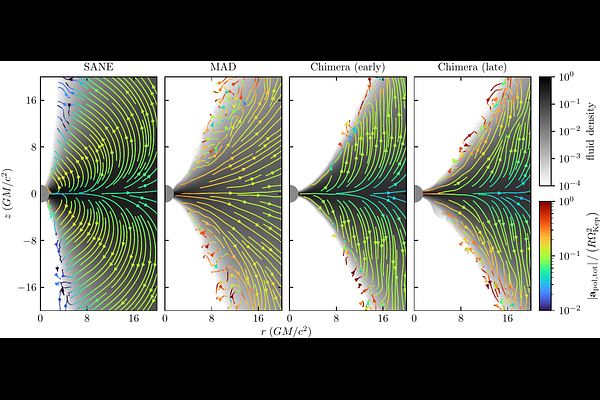
AbstractNon-radiative black hole accretion flows are commonly classified by their magnetic flux state, with standard and normal evolution (SANE) disks and magnetically arrested disks (MADs) marking the usual weak- and strong-flux regimes. We compare three-dimensional general relativistic magnetohydrodynamics simulations of a weakly magnetized SANE flow, a standard MAD, and a Chimera flow fed by a different reservoir of mass, angular momentum, and coherent magnetic flux. The Chimera reaches a MAD-level horizon magnetic flux and launches a powerful electromagnetic jet during an extended non-eruptive interval, showing that a flow can maintain large horizon flux and jet power without sharing the standard MAD's bursty horizon-flux variability, mass-flow distribution, or inner-flow morphology. In the SANE flow, we show that radial support is primarily hydrodynamic and provided by gas pressure gradients, whereas in MAD flows, magnetic pressure and tension enter the radial force budget at comparable order and help regulate the inner flow dynamics. The Chimera remains distinct from the standard MAD in its density structure, funnel-wall geometry, mass-flow channels, radial force budget, and angular-momentum transport throughout the analyzed evolution. We therefore argue that MAD-like behavior is not captured by any single diagnostic, but by a dynamical coupling among horizon flux, jet power, magnetic support, Maxwell transport, surface-layer flow, disk morphology, and eruption activity. The Chimera shows that these outcomes can be separated by accretion history and magnetic-flux supply.