The structure of the apo-PIWI HSP90 complex

The structure of the apo-PIWI HSP90 complex
Donlon, P.; Sotelo-Parrilla, P.; MacKenzie MacLeod, D.; Rosinska, A.; Chowdhury, T.; Leith, K. I.; Zoch, A.; Spanos, C.; Cook, A. G.; Jeyaprakash, A. A.; OCarroll, D.
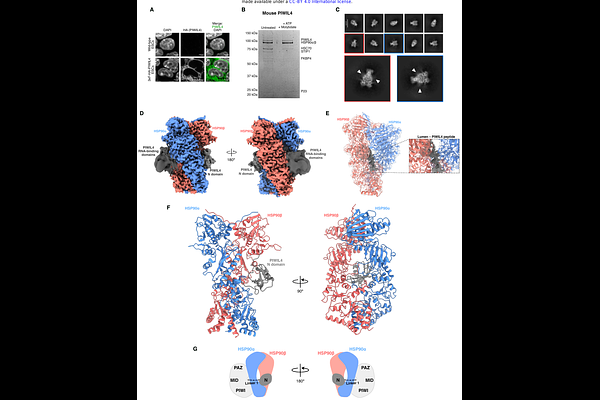
AbstractPIWI proteins are members of the Argonaute family and together with piRNAs protect metazoan germlines from transposons. PIWI proteins adopt a bi-lobed architecture with a central RNA-binding channel. HSP90 function has been linked to piRNA biogenesis, but the precise molecular mechanism is unresolved. Using the mammalian embryonic piRNA pathway as a model system, we find compelling evidence for the existence of PIWIL2- (MILI-) and PIWIL4- (MIWI2-) HSP90 complexes in foetal testis. We purify apo-PIWIL4-HSP90 from cells and determine its structure by cryo-electron microscopy. Distinct from piRNA-bound PIWI, apo-PIWIL4 adopts a unique and open conformation. The HSP90 dimer binds and unfolds PIWIs linker 1 domain. PIWIL4s N domain and the RNA-binding PAZ-MID-PIWI module are placed on opposite sides of the HSP90 dimers lumen. We further demonstrate that PIWI-HSP90 complexes, the open apo-PIWI conformation, and the HSP90 lumen-binding peptide are conserved features of PIWI proteins.