A bright X-ray flaring event from the intermediate supergiant fast X-ray transient IGR J00370+6122 observed with NuSTAR

A bright X-ray flaring event from the intermediate supergiant fast X-ray transient IGR J00370+6122 observed with NuSTAR
L. Ducci, M. M. Serim, P. Romano, E. Bozzo, L. Ji, C. Malacaria
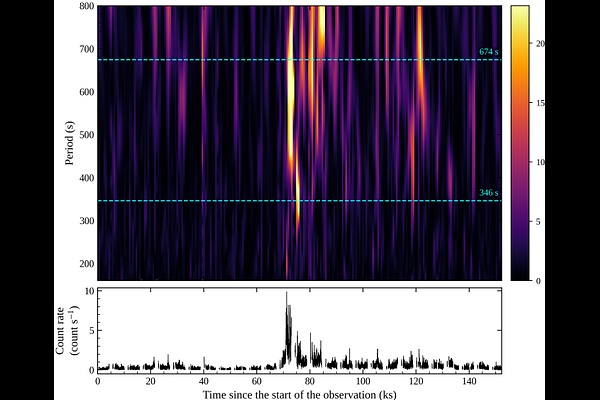
AbstractWe present an analysis of a long NuSTAR observation of the intermediate supergiant fast X-ray transient (SFXT) IGR J00370+6122, obtained around the peak of its orbital modulation. The observation has a net exposure ~93 ks. During the observation, the source displayed a bright flaring event that was resolved into numerous short flares with durations of 10-1000 s. The 3-70 keV luminosity spanned a dynamic range of ~200, from ~1E34 to ~1.8E36 erg/s; the maximum was reached for only ~40 s in total. The spectrum is well described by an absorbed double-Comptonisation model, with parameters consistent with those found in other X-ray pulsars accreting at similarly low luminosities. This is the first detection of a double-hump continuum in IGR J00370+6122, which extends this spectral state to the class of intermediate SFXTs. We searched for the previously reported ~346 s and ~674 s periodicities and find no significant signal at either period, which makes their interpretation as the neutron star spin period less likely. Using ~21 yr of Swift/BAT monitoring, we refine the orbital period of the system to P_orb=15.6654 +/- 0.0008 d. Finally, we discuss the observed flaring activity in the framework of quasi-spherical settling accretion, which is expected at the observed luminosities.