A practical framework for measuring protein oligomerization equilibria by fluorescence correlation spectroscopy

A practical framework for measuring protein oligomerization equilibria by fluorescence correlation spectroscopy
Rathod, D.; Parrott, K.; Levitus, M.
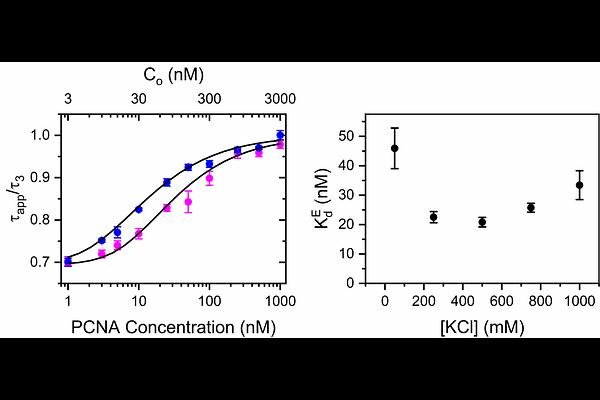
AbstractProtein oligomerization equilibria are central to many biological processes and are often highly sensitive to environmental conditions such as ionic strength, pH, and ligand binding. Quantitative characterization of these equilibria remains experimentally challenging because stable protein complexes frequently dissociate only at concentrations that are difficult to access with conventional biophysical methods. Fluorescence correlation spectroscopy (FCS) is uniquely suited to this problem, as it provides direct access to diffusion coefficients of fluorescently labeled proteins at nanomolar concentrations. However, the quantitative interpretation of FCS data from oligomeric systems requires a rigorous mathematical framework and careful experimental practice that have not previously been described in sufficient detail to guide implementation. Here, we provide a comprehensive description of the experimental workflow and analytical framework for determining dissociation equilibrium constants by FCS, covering instrument calibration, sample preparation, data quality control, afterpulse correction, and nonlinear least-squares fitting. We discuss common sources of error and provide practical guidance on critical experimental considerations including surface passivation, buffer preparation, equilibration time, and the role of labeling efficiency. Using the homotrimeric sliding clamp PCNA as a model system, we demonstrate the complete workflow under a range of KCl concentrations and show that moderate ionic strength stabilizes the PCNA trimer while very high salt partially destabilizes the complex. The approach is general and applicable to any reversible protein self-association reaction accessible by fluorescence detection at low protein concentrations