Ligand Binding Free Energy Landscapes at the Tubulin Colchicine Site from Coarse-Grained Metadynamics

Ligand Binding Free Energy Landscapes at the Tubulin Colchicine Site from Coarse-Grained Metadynamics
Grazzi, A.; Brown, C. M.; Sironi, M.; Marrink, S.-J.; Pieraccini, S.
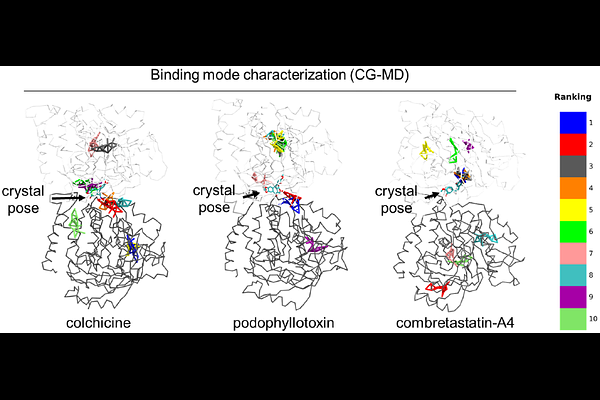
AbstractAccessing deeply buried binding sites remains a major challenge in structurebased drug discovery, where accurate description of both protein dynamics and ligand binding pathways is required. Funnel metadynamics enables simulation of complete binding processes but is computationally demanding at the all-atom resolution. By adopting the Martini 3 force field, coarse-grained funnel metadynamics (CG-FMD) substantially reduces computational requirements while retaining enhanced sampling capabilities. In this work, we assess the capability of CG-FMD to model ligand recognition at the deeply buried colchicinoids site of the tubulin {beta}-heterodimer, a multisite protein of strategic importance. We investigated the binding of colchicine, podophyllotoxin and combretastatin-A4, recovering free energy profiles with improved statistical convergence compared to AA-FMD and comparable to experimental references. In particular CG-FMD binding free energies present mean absolute errors between 3 and 10 kJ mol-1. These results propose CG-FMD as an efficient, physics-based framework for probing ligand binding to challenging sites.