The Environmental Effects on Inspiraling Binary Black Hole Systems in the Centers of the LMC and M31

The Environmental Effects on Inspiraling Binary Black Hole Systems in the Centers of the LMC and M31
Meng Xu, Zhijin Li, Xiao Guo, Yun-Long Zhang
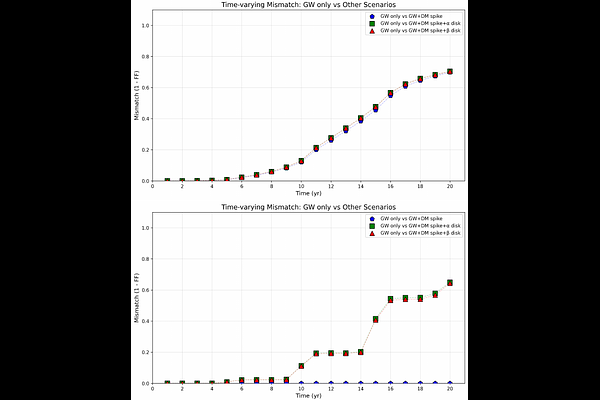
AbstractBinary black hole (BBH) systems residing in the centers of galaxies evolve within complex astrophysical environments. These environments, comprising dark matter (DM) halos and baryonic accretion disks, can significantly alter the orbital dynamics of the binaries and their resulting gravitational wave (GW) emission. In this study, we investigate the dynamical evolution and GW waveforms of BBH systems embedded in the centers of the Large Magellanic Cloud (LMC) and the Andromeda Galaxy (M31). We construct a comprehensive analytical framework that jointly incorporates GW radiation reaction, DM spike effects (including dynamical friction and accretion, derived from the Navarro-Frenk-White profile), and accretion disk perturbations. Using this framework, we track the long-term evolution of the binary's semi-latus rectum $p$ and orbital eccentricity $e$. Our simulations reveal that the coexistence of a DM spike and an accretion disk significantly accelerates the inspiral process compared to pure DM or vacuum scenarios. Crucially, to assess the observability of these environmental effects, we calculate the Signal-to-Noise Ratio (SNR) and waveform Mismatch for future Pulsar Timing Arrays (PTAs). Our analysis demonstrates that these systems can achieve robust detectability thresholds ($\text{SNR} \ge 8$) within specific parameter spaces. Furthermore, the substantial Mismatch (reaching $\sim 0.7$ over a 20-year observation in the LMC scenario) indicates that the phase deviations induced by these environmental effects are highly distinguishable from vacuum templates. These findings predict the prospect of using future GW detections to probe complex galactic environments.