A lateral linker histone binding mode scaffolds dinucleosome stacking in chromatin fibers

A lateral linker histone binding mode scaffolds dinucleosome stacking in chromatin fibers
Dong, A.; Wang, Y.; Yang, S.; Wang, J.; Wu, X.; Zhou, D.; Liu, P.; Zha, R.; Sun, J.; Zhang, J.; Lin, J.; Zhou, H.; Gan, J.
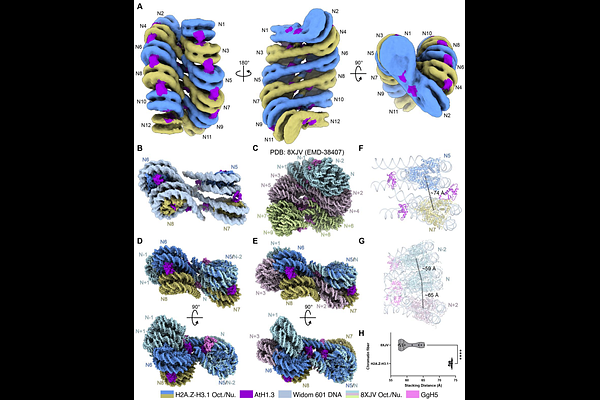
AbstractLinker histones are essential for chromatin compaction, yet how they contribute to higher-order fiber assembly remains poorly understood. Here, we determined cryo-electron microscopy structures of Arabidopsis dodeca-nucleosome fibers containing distinct H2A/H3 variants and linker histone H1.3, revealing a noncanonical binding mode that a laterally positioned H1.3 connects the acidic patch of one nucleosome and the DNA of the neighboring nucleosome, thereby scaffolding dinucleosomes into two-start chromatin fibers. This noncanonical binding mode is structurally conserved when H1.3 is replaced by Gallus gallus H5. Furthermore, incorporation of H2A.W and H3.3 further induces back-to-back fiber dimerization. Cryo-electron tomography and in vivo cross-linking mass spectrometry analyses support the physiological relevance of H1 lateral engagement. Our findings establish that linker histones act as active architectural scaffolds in higher-order chromatin organization.