Long-read sequencing reveals novel mitochondrial genome variants undetected by short-read sequencing in Korean population

Long-read sequencing reveals novel mitochondrial genome variants undetected by short-read sequencing in Korean population
Kim, H. J.; Kim, S. M.; Yoon, K.; Kim, B.-J.; Jin, H. J.; Kim, Y. J.
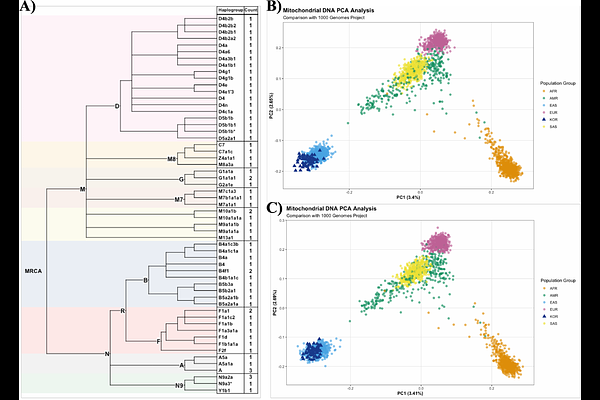
AbstractWhile long-read sequencing technologies (e.g., PacBio Revio, ONT) have revolutionized high-quality genome assembly for the human pangenome, mitochondrial genome (mtDNA) analysis still largely relies on short-read and Sanger sequencing. However, short-read sequencing often lacks the resolution required to resolve complex variations due to the unique features of mtDNA, such as high mutation rates and repetitive homopolymeric regions, which frequently lead to alignment artifacts and mapping ambiguities. To address this, we evaluated whether applying long-read sequencing to mtDNA improves analytical quality in empirical data. Through comprehensive bioinformatics analyses, we compared the performance of long-read sequencing against short-read sequencing and microarrays. Our results revealed that long-read sequencing detected the highest number of variants (n = 533), significantly outperforming both short-read sequencing (n = 525) and microarrays (n = 49). Notably, both sequencing methods provided significantly higher resolution in haplogroup assignment compared to microarrays in terms of phylogenetic depth (p < 0.05). Long-read sequencing demonstrated superior detection power, particularly for InDels. We identified two novel non-synonymous variants, including a unique InDel detected exclusively by long-read sequencing. Protein modeling and stability analysis validated that this InDel causes structural instability (RMSD > 2.0 [A], G = -45.21 kcal/mol). Furthermore, we confirmed that this novel InDel is shared among haplogroup A samples in both the 1000 Genomes Project ONT dataset and the Korean population, highlighting the practical implications of long-read sequencing for molecular biology and population genetics.