Natural genetic variation reveals divergent transcriptomic responses to hyperoxia in two Chlamydomonas reinhardtii ecotypes

Natural genetic variation reveals divergent transcriptomic responses to hyperoxia in two Chlamydomonas reinhardtii ecotypes
Temple, J. A.; Neofotis, P. G.; Lucker, B. F.; Bibik, J. D.; Kramer, D. M.; Strenkert, D.
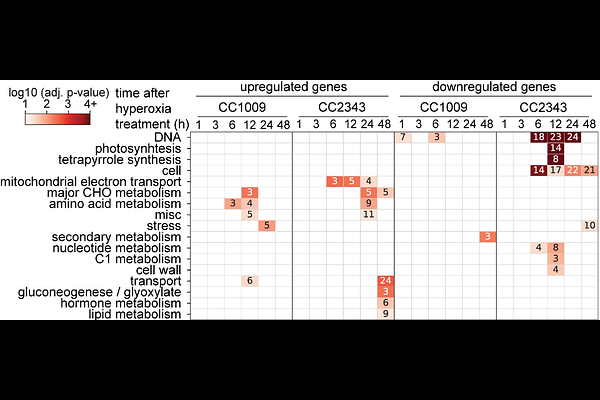
AbstractGreen algae must continuously balance resource availability to maintain photosynthetic performance. The O2:CO2 ratio is a key determinant of their metabolic mode. Under hyperoxia or low CO2, many algae induce a carbon concentrating mechanism (CCM). In the model green alga Chlamydomonas reinhardtii, the CCM relies on a pyrenoid, a specialized microcompartment that elevates CO2 around rubisco. While ambient CO2 acclimation is well-studied, responses to hyperoxia remain poorly understood, despite its frequent occurrence in nature under high light. Using controlled bioreactors, we exposed two diverse Chlamydomonas ecotypes, CC1009 and CC2343, to 95% oxygen to analyze time-dependent, genome-wide transcriptomic and phenotypic changes. Both ecotypes induced CCM genes, but they exhibited distinct molecular and physiological phenotypes. The tolerant ecotype (CC1009) successfully adapted, developing a functional CCM with a structured starch sheath. Conversely, the sensitive ecotype (CC2343) suffered growth arrest and formed malformed pyrenoids. Transcriptomics revealed that CC1009 initiated a rapid initial response, upregulating chloroplast proteostasis and downregulating nucleotide metabolism. CC2343 showed a massive, delayed transcriptional response, downregulating genes coding for photosystems and tetrapyrrole biosynthesis. This unbiased transcriptomic approach identifies key candidate genes driving algal acclimation to hyperoxic stress in natural, high-light environments.