Quantum-Informed Portfolio Selection: An End-to-End Pipeline Validated on Trapped-Ion Hardware with Real Market Data

Quantum-Informed Portfolio Selection: An End-to-End Pipeline Validated on Trapped-Ion Hardware with Real Market Data
Romina Yalovetzky, Martin J. A. Schuetz, Zichang He, Jiayu Shen, Yue Sun, Rudy Raymond, Shauna Sahay, Kishore Perla, Ruben S. Andrist, Grant Salton, Helmut G. Katzgraber, Roger Bongiovanni, Niraj Kumar, Rob Otter
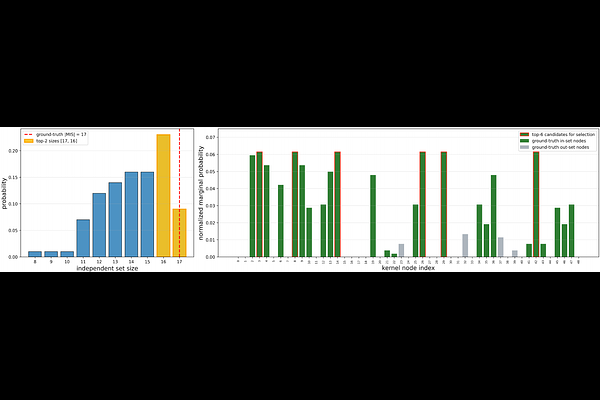
AbstractPortfolio diversification - a cornerstone of modern investment management - can be formulated as a Maximum Independent Set (MIS) problem on asset correlation graphs. Solving this problem at scale is computationally challenging, motivating the exploration of quantum algorithms for practical financial optimization. We propose an end-to-end pipeline leveraging qReduMIS, a recursive hybrid quantum-classical algorithm. Rather than using quantum optimization to directly produce a final solution, qReduMIS leverages independent set measurements from the Quantum Approximate Optimization Algorithm (QAOA) to identify frozen nodes - vertices likely to belong to optimal solutions - thereby guiding and unblocking subsequent (provably optimal) classical reductions on the remaining graph. We benchmark qReduMIS on real financial data from four major market indices with up to 225 assets, executing experiments on Quantinuum's 98-qubit trapped-ion Helios system, with QAOA circuits acting on kernels of up to 78 qubits and 1016 two-qubit gates. While standalone QAOA fails to find the optimal solution for two of the largest indices (S&P 100 and Nikkei 225), qReduMIS achieves success probabilities of $0.40$ and $0.95$, respectively, with average approximation ratios $\geq 0.96$ across all four indices. We perform a systematic benchmark on the Quantinuum H2-1 noisy emulator over 73 asset correlation graphs of varying size showing that, for $p=2$ QAOA layers, the optimal time-to-solution scaling exponent of qReduMIS is $3.2$ times smaller than that of standalone QAOA.