Polynomial equivalence of the global transverse-field Ising model and the gate model of quantum computation

Polynomial equivalence of the global transverse-field Ising model and the gate model of quantum computation
Matthias Werner
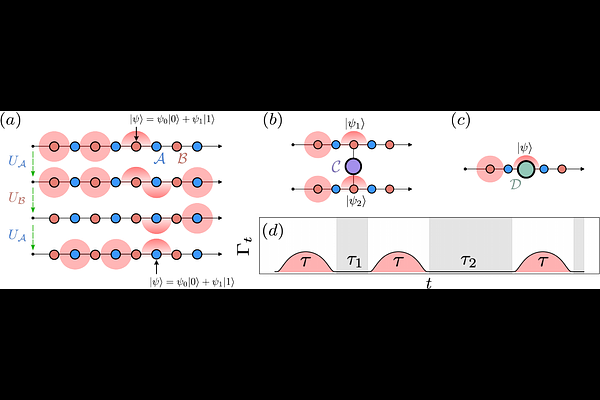
AbstractThe transverse-field Ising model has attracted a lot of attention in recent years, especially in the quantum simulation and quantum computation literature. This interest is driven by many platforms for analog quantum computation, which implement the transverse-field Ising model for solving optimization problems, such as quantum annealing. However, it has remained an open question whether the Ising model with a global transverse field is equivalent to the gate model of quantum computation. Here we answer this question affirmatively for the case of a non-monotonic time-dependent transverse field. Building on a recent result by Cesa and Pichler on global control of Rydberg atoms, we provide a construction that allows simulating arbitrary quantum circuits using the Ising model with global transverse field with polynomial overhead in time, qubit number, and energy scale. Although the polynomial overheads we establish here are large relative to what is feasible on real-world quantum hardware, our result motivates the development of more sophisticated methods for simulating quantum circuits using the Ising model with a global transverse field. Additionally, under the assumption that quantum computing is strictly more powerful than classical computing, our result serves as a no-go theorem for efficient classical simulation of the transverse-field Ising model with a time-dependent global transverse field. Therefore, our finding is relevant for multiple communities, from analog quantum simulation and quantum optimization on various platforms to complexity and control theory.