Early microglial activation in the TME enables FLASH-RT to eradicate medulloblastoma while promoting neuron-astrocyte crosstalk to minimize toxicity in the hippocampus

Early microglial activation in the TME enables FLASH-RT to eradicate medulloblastoma while promoting neuron-astrocyte crosstalk to minimize toxicity in the hippocampus
Knol, M.; Franco Perez, J.; Almeida, A.; Kunz, L. v.; Petit, B.; Job, A.; Ollivier, J.; Romero, C. J.; Jansen, J.; Grilj, V.; Limoli, C.; Vozenin, M.-C.; Ballesteros Zebadua, P.
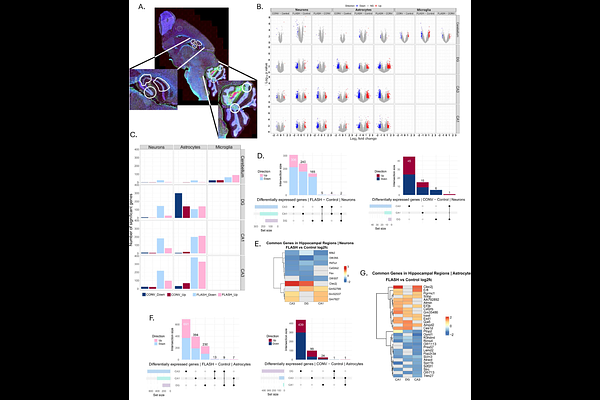
AbstractBackground: FLASH-RT defines a promising treatment modality against medulloblastoma, as it minimizes treatment-related complications. To support its clinical translation, we dissected the cellular and molecular determinants of the FLASH response in the tumor-microenvironment (TME) and healthy hippocampus using an orthotopic human medulloblastoma mouse model treated with a hypo-fractionated FLASH regimen. Methods: Five cohorts of 4 weeks-old UW228-MB-bearing female nude mice (n=57) were irradiated, or sham-irradiated using 3x10 Gy (BED=60), delivered 48h apart at 0.1 Gy/s (CONV) or 5.5x10⁶ Gy/s (FLASH) using an electron beam (eRT6). Digital spatial profiling (DSP) was performed 24h after radiotherapy in one cohort, while the four other cohorts were followed for long-term tumor response, cognition, and neuroinflammation. Results: Both CONV and FLASH-RT induced a complete and long-lasting anti-tumor response in 100% of animals associated with cognitive decline. However, more mice maintained a very good discrimination score after FLASH exposure (38%) than CONV (7%). DSP revealed a sustained microglial activation in the cerebellar tumor micro-environment, where FLASH enhanced expression of genes with phagocytic and proteolytic activity. In the tumor free hippocampus, FLASH exposure induced a preferential neuron/astrocyte transcriptional crosstalk, which manifested over protracted times to minimize neuroinflammation and cognitive complications. Conclusion: The study shows the tumor-ablative efficacy of hypo-fractionated FLASH-RT in a human medulloblastoma mouse model. It is associated with qualitatively distinct transcriptional signatures prone to tumor and debris clearance mediated by microglial cells of the TME. Moreover, in the hippocampus, FLASH mitigates radiation-induced neurotoxicity by enhancing genes involved in synaptic plasticity, attenuating neuroinflammation, and preserving metabolic function.