Multi-Epoch X-Ray Detection of SLSN-I 2018bsz: Constraints on the Powering Mechanism and Ejecta Structure

Multi-Epoch X-Ray Detection of SLSN-I 2018bsz: Constraints on the Powering Mechanism and Ejecta Structure
Julia Ahlvind, Josefin Larsson, Dennis Alp, Ragnhild Lunnan
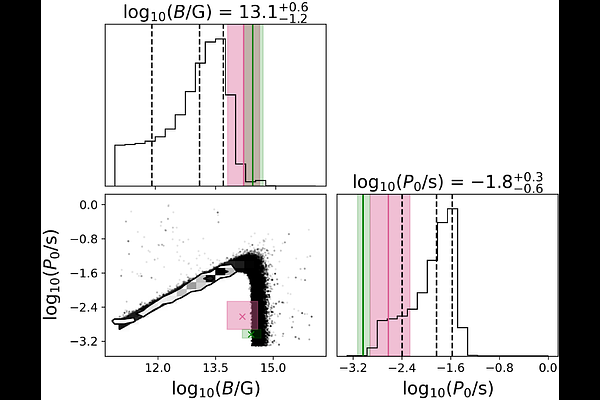
AbstractSN 2018bsz is the closest known stripped superluminous supernova (SLSN-I) to date, making it an ideal laboratory for investigating the physical mechanisms powering this class of extreme explosions. We present a multi-epoch X-ray spectroscopic study of SN 2018bsz based on four Chandra observations followed by one XMM observation, spanning 87 to 1253 days after explosion. The source is detected at all Chandra epochs and is also tentatively detected in the late XMM observation, although more uncertain due to nearby contaminating sources. Regardless of the XMM detection, this makes SN 2018bsz the second X-ray detected SLSN-I and the third X-ray detected SLSN overall. We explore potential power sources for the observed X-ray emission and find that a millisecond (ms) magnetar central engine underpredict most of the observed X-ray luminosities and fail to reproduce the relatively flat light curve. Accounting for ejecta absorption further increases the discrepancy. While asymmetries and magnetar-driven ionization could reduce the effective absorption, ionization breakout is expected years after our observational window. Instead, the observations are more readily explained by early-time interaction between the ejecta and the circumstellar medium, while the magnetar emission is absorbed by the ejecta. This scenario is supported by the flat temporal evolution, previous optical results, and inferred mass-loss rates which resemble those of stripped SNe that later evolve into interacting systems. Our results thus favor the scenario where SN 2018bsz is part of a distinct group of SLSN-I, where interaction is crucial for the strong emission.