Reconstructing sequence-grammar trajectories enables interpretable and tunable cis- regulatory element design

Reconstructing sequence-grammar trajectories enables interpretable and tunable cis- regulatory element design
Ma, M.; Bu, W.; Liu, G.; Liu, Y.; Liu, S.; Zhao, Z.; Yao, S.; Hua, Q.; Zhang, Y.; Zhong, C.; Huang, H.; Deng, P.; Jin, P.; Yin, Q.; Cao, C.; Liu, H.; Xu, M.; He, Y.; Qin, T.; Chen, Z.
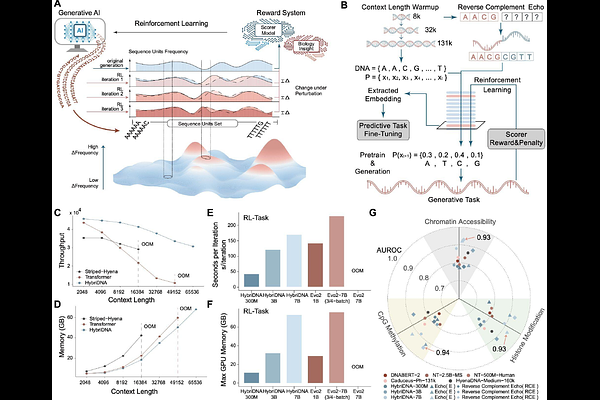
AbstractDesigning synthetic cis-regulatory elements (CREs) with cell-type-specific activity is critical for precision gene and cell therapies, but remains challenging because optimization is often treated as a black box, obscuring how regulatory grammar emerges and how failed trajectories can be corrected. Here, we present GO-CRE (Guided Optimization of Cis-Regulatory Elements), a deep learning framework that integrates efficient sequence generation, predictor-guided reinforcement learning, and trajectory-level interpretation. GO-CRE reconstructs iterative sequence changes in a shared sequence-grammar landscape and identifies coordinated update programs corresponding to search, commitment, and optimization. In HepG2, GO-CRE revealed a low-complexity polyG trap and redirected optimization toward functional motif programs by introducing a polyG penalty. Final designs in HepG2 and K562 progressively acquired cell-type-associated grammar while retaining sequence diversity. Lentiviral massively parallel reporter assays validated cell-type-specific activity in K562 and HepG2 and showed higher average activity of HepG2 designs than endogenous CREs. Together, these findings establish sequence-grammar trajectory reconstruction as a basis for interpretable and tunable synthetic CRE design.