Taxonomic Resolution of 16S rRNA, FastANI, Mash, and FastAAI across 30,495 Prokaryotic Type-Strain Genomes

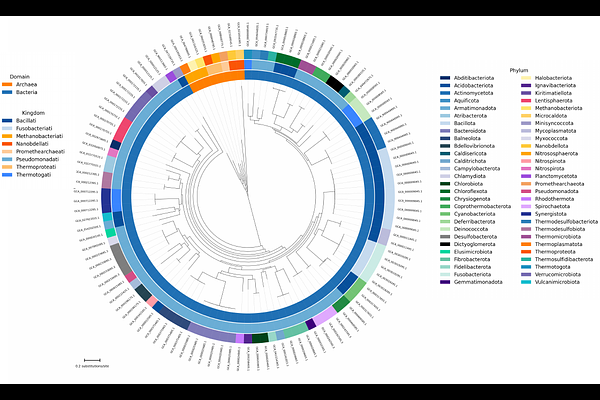
Taxonomic Resolution of 16S rRNA, FastANI, Mash, and FastAAI across 30,495 Prokaryotic Type-Strain Genomes
Ussery, D.; Bukharid, M. Z.; Majumder, R.; Borin, V. A.; Alisoltani, A.
AbstractProkaryotic taxonomy now relies on both marker-gene and genome-wide sequence comparisons, but these methods differ in taxonomic range, scalability, and sensitivity to genome quality. Here, we benchmarked four commonly used approaches, including 16S rRNA identity, FastANI, Mash distance, and FastAAI/Jaccard similarity across a dataset of 30,495 prokaryotic type-strain genomes. Type-strain genomes provide nomenclatural anchors for validly named species, making them a useful framework for evaluating how sequence-based methods correspond to current taxonomic assignments. We evaluated method behavior across taxonomic ranks from species to domain and separated initial method failures from threshold-based failures. When clean full-length 16S rRNA sequences were available, same-species comparisons passed the empirical threshold in >97% of cases. However, a usable full-length 16S rRNA sequence was unavailable for 4,551 of the 16,402 same-species comparisons (28%), limiting marker-gene-based analysis. In addition, 16S rRNA identity ranges overlapped across higher taxonomic ranks, limiting the use of universal rank-specific cutoffs. FastANI provided strong species-level resolution, with same-species comparisons passing the empirical threshold in approximately 88% of cases but was less informative at deeper ranks. Mash enabled rapid genome-scale screening, although its distance values require careful interpretation beyond close relatives. FastAAI provided a genome-wide amino-acid signal, with approximately 92% of same-species comparisons passing the empirical threshold and was especially useful for comparisons beyond the species boundary. Overall, no single method performed optimally across all taxonomic levels. These results support a rank-aware benchmarking framework in which 16S rRNA, FastANI, Mash, and FastAAI are interpreted as complementary tools, with attention to genome quality, missing data, and method-specific failure modes.