Haplotype-resolved Genome Assemblies of Hybrid Wheatgrass and Bluebunch Wheatgrass Reveal the Stepwise Polyploid Origin and Biased Subgenome Dominance

Haplotype-resolved Genome Assemblies of Hybrid Wheatgrass and Bluebunch Wheatgrass Reveal the Stepwise Polyploid Origin and Biased Subgenome Dominance
Ji, Y.; Chaudhary, R.; Khan, N.; Perumal, S.; Wang, Z.; Moghanloo, L.; Hucl, P.; Biligetu, B.; Sharpe, A. G.; Jin, L.
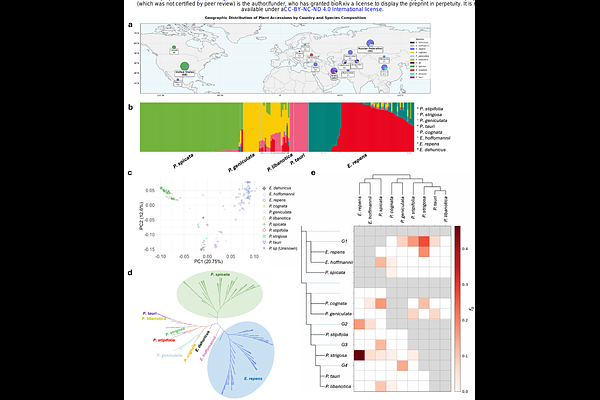
AbstractConcerns over climate change have intensified the demand for stress resistant crops like hybrid wheatgrass (HWG; Elymus hoffmannii, StStStStHH), a perennial forage species known for its exceptional salt and drought tolerance. However, hexaploidy and high heterozygosity have complicated efforts to resolve its genomic structure and evolutionary history. Here, we present high-quality, haplotype-resolved, chromosome-level genome assemblies for HWG (CDC Saltking) and its putative progenitor, bluebunch wheatgrass (Pseudoroegneria spicata). By integrating PacBio HiFi and ultra-long Oxford Nanopore sequencing with Hi-C scaffolding, we assembled the 10.7 Gb HWG genome into 21 pseudochromosomes per haplotype. Our phylogenomic analysis redefines the origin of the H subgenome, positioning it as an intermediate between Old-World Hordeum marinum (sea barley) and Hordeum brevisubulatum. Notably, we identified significant chromosomal rearrangements, including a unique duplication on St chromosome 4. Transcriptome analysis across multiple tissues revealed a pronounced expression dominance of the H subgenome. This dominance was not associated with reduced LTR density, suggesting that selective pressures for rapid adaptation of the latest subgenome entrant may drive its dominance. Finally, using the f-branch statistic, population genomic analysis of 189 accessions representing eight Elymus and Pseudoroegneria species revealed extensive reticulate evolutionary relationships and identified P. spicata as a major, asymmetric genetic donor within the wheatgrass complex. These resources provide a foundational framework for future genomic research and genetic improvement in grasses and for the introgression of stress-tolerance traits into cereal crops such as wheat.