CXCL12/CXCR4 Governs Lymphatic Valve Formation Through Flow Dependent AKT/FOXO1/FOXC2 Activation

CXCL12/CXCR4 Governs Lymphatic Valve Formation Through Flow Dependent AKT/FOXO1/FOXC2 Activation
Pang, J.; Do, L. N. H.; Delgado, E.; Flynn, L.; Liu, H.; Liu, X.
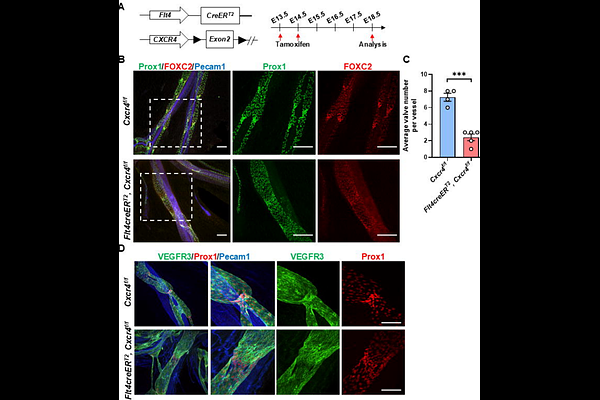
AbstractBackground: Lymphatic valves are specialized structures within lymphatic vessels that ensure unidirectional lymph transport. Defective lymphatic valve formation is associated with lymphedema, a chronic disease characterized by impaired lymph drainage and the accumulation of protein rich interstitial fluid. Lymphatic valves form during late embryonic stages in mice, with oscillatory shear stress implicated in regulating the molecular mechanisms which control lymphatic valve formation. However, the molecular mechanisms governing lymphatic valve formation remain incompletely understood. Although CXCR4 is regulated by shear stress in blood vessels, whether CXCL12/CXCR4 signaling regulates lymphatic valve formation and the underlying molecular mechanisms remain unknown. Methods: To investigate the roles of CXCR4 in the regulation of lymphatic valve development, we utilized lymphatic endothelial cell (LEC) specific Cxcr4 knockout (Flt4CreERT2, Cxcr4f/f) mice. To determine the source of CXCL12, major ligand for CXCR4 in the mesentery, we used global Cxcl12-/-, and Cxcl12-DsRed knock-in/knockout (KIKO) reporter mice, as well as conditional Cxcl12 knockout mouse lines. To determine the molecular mechanisms by which CXCL12/CXCR4 regulates lymphatic valve development, primary human dermal LECs were exposed to oscillatory shear stress (OSS) to mimic valve-associated flow, followed by analysis of downstream signaling pathways and valve related gene expression. Results: LEC specific loss of CXCR4 displayed impaired lymphatic valve development. Flt4CreERT2, Cxcr4f/f mice showed a significant reduction in valve numbers in embryonic mesenteric lymphatic vessels. Similarly, reduced valve numbers were observed in Cxcl12-/- embryos, indicating CXCL12/CXCR4 is required for embryonic mesentery collecting lymphatic valve formation. Cxcl12-DsRed KIKO mice revealed that blood vessels, opposed to nerves, were the major source of CXCL12 in the embryonic mesentery. In align with this finding, EC-specific Cxcl12 deletion recapitulated defective valve phenotypes observed in Cxcl12 -/- embryos. Mechanistically, CXCR4 knockdown in primary human dermal LECs attenuated OSS induced phosphorylation of AKT and FOXO1, leading to increased nuclear localization of FOXO1 and reduced expression of FOXC2, an essential transcription factor governing lymphatic valve development. Consistent with these findings, lymphatic valves of LEC-Cxcr4 deficient mice exhibited increased FOXO1 nuclear localization. Importantly, pharmacological activation of AKT reduced FOXO1 nuclear accumulation and restored lymphatic valve numbers in LEC Cxcr4 deficient mesenteric lymphatic vessels. Conclusions: Our findings reveal CXCL12/CXCR4 signaling acts as a critical regulator of lymphatic valve development. CXCL12/CXCR4 signaling integrates into the flow dependent AKT/FOXO1/FOXC2 signaling axis to coordinate lymphatic valve development and morphogenesis. Taken together, our study uncovers a previously unknown role of CXCL12/CXCR4 signaling pathway in the regulation of lymphatic valve development. Targeting CXCL12/CXCR4/AKT/FOXO1 axis may represent a promising therapeutic strategy for improving lymphatic valve development to improve lymphatic function for the treatment of lymphedema.