Change in topological linking number during Xer recombination at the plasmid pSC101 psi site

Change in topological linking number during Xer recombination at the plasmid pSC101 psi site
Provan, J. I.; Tomatcheva, A. O.; Sherratt, D. J.; Colloms, S. D.
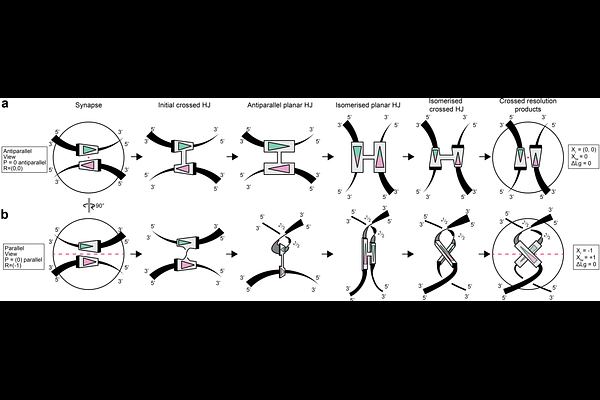
AbstractThe XerC and XerD recombinases function with accessory proteins PepA, ArcA and ArgR at plasmid recombination sites such as psi and cer, to keep multicopy plasmids in a monomeric state and ensure stable plasmid inheritance. Xer recombination acts on plasmid recombination sites only if they are directly repeated and recombination produces a specific catenane in which the two product circles are interlinked around each other exactly four times. Here we measure the precise change in topological linkage ({Delta}Lk) that occurs during Xer recombination at psi. We use a DNA substrate with close-spaced psi sites that recombines to produce one circle of 398 bp and another of 3039 bp and demonstrate that the small circle is exclusively the -1 topoisomer. Using a purified topoisomer of the substrate, we show that Xer recombination proceeds with a linkage change ({Delta}Lk) of +4. Similar experiments using a substrate with equally spaced psi sites agreed with this result. The measured linkage change is consistent with a reaction mechanism for tyrosine recombinases in which the sites align antiparallel prior to recombination and recombine via a Holliday junction intermediate. Four negative supercoils are converted to catenation nodes by strand exchange, providing an energetic driving force for the reaction. We compare this to the mechanism of serine recombinases and the recently discovered bridge RNA-guided recombinases.