Noncanonical Circular RNAs and Potential Functions

Noncanonical Circular RNAs and Potential Functions
Li, K.; Wang, W.; Negesso, A. E.; Deng, J.; Qin, H.; Jiang, J.; Ma, K.; Zhang, J.; Wei, P.; Li, D.; Kong, F.-M. S.; Cho, W. C.; Qiu, S.; zhang, w.
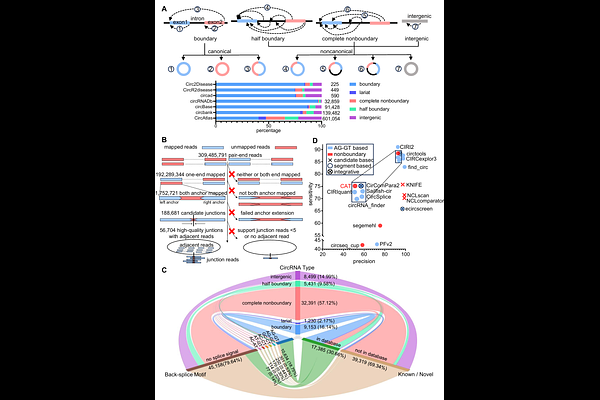
AbstractCircular RNAs (circRNAs) are ubiquitous in eukaryotes; dysregulated circRNA expression is linked to diseases, including lung cancer. In contrast to canonical circRNAs arising from exon-intron boundaries, noncanonical circRNAs originating within exonic, intronic, and intergenic regions have typically been dismissed as transcriptional noise or technical artifacts. To explore circRNA diversity and appreciate their functions, we developed an algorithm to identify both canonical and noncanonical circRNAs without relying on genome annotation, enabling the identification of circRNAs of all types and in newly sequenced or poorly annotated species. Results from lung cancer cells revealed that noncanonical circRNAs constituted over two-thirds of the circRNA population and were expressed more abundantly than canonical circRNAs, and genes with fewer and shorter exons were hotspots for noncanonical circRNA and circRNA isoform production. Further analyses showed that many noncanonical circRNAs were indeed endogenous circRNAs transcribed within cells rather than experimental artifacts, were potentially translated into proteins or peptides, and were conserved across species. Moreover, we validated 65 noncanonical circRNAs in NCI-H23 cells using multiple bioassays and demonstrated that both exonic and intergenic noncanonical circRNAs influenced cell viability. CircRNA profiles in tumor and tumor-adjacent tissues of lung cancer patients revealed tissue-specific expression and differentially expressed canonical and noncanonical circRNAs from cognate genes involved in cancer-related pathways, indicating their potential clinical relevance. This study confirmed the authenticity of noncanonical circRNAs and provided the first experimental evidence that noncanonical circRNAs influence cancer cell phenotypes. These findings broaden our understanding of circRNA biology, highlighting their widespread genomic distribution, diverse functions, and potential clinical relevance.