A pipeline for identifying small noncoding RNA (sRNA) candidates in bacteria

A pipeline for identifying small noncoding RNA (sRNA) candidates in bacteria
Elhedi, S.; NDiaye, K. D. S.; Perreault, J.
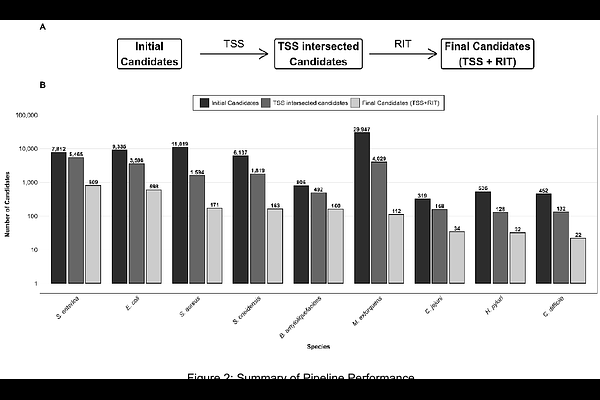
AbstractBacterial small non-coding RNAs (sRNAs) are central post-transcriptional regulators, yet their computational identification suffers from high false-positive rates due to transcriptional noise and the absence of canonical coding features. We developed a three-stage pipeline integrating sRNA prediction (sRNA-Detect), transcription start site mapping (TSSAR, dRNA-seq), and Rho-independent terminator detection (RNIE), applied across nine phylogenetically diverse bacterial species spanning six phyla. Sequential filtering achieved 1.4 to 33 fold precision improvements across nine species, reducing candidate sets by up to 99.6% while recovering known sRNAs at rates reflecting reference database depth (6% recall in S. aureus, 33-34% in E. coli and S. enterica) TSS and RIT constraints constitute universal, genome-size-independent biological filters that substantially enrich sRNA predictions across bacterial diversity. Precision variation across species reflects database incompleteness rather than pipeline failure, with unmatched predictions in poorly annotated organisms representing candidate novel sRNAs rather than false positives. RNA-seq coverage depth provides a reliable secondary indicator of biological relevance, though its interpretation requires accounting for sequencing depth variation across datasets.