CutBackdoor: A Circuit Cut Triggered Backdoor Attack on Variational Quantum Algorithms

CutBackdoor: A Circuit Cut Triggered Backdoor Attack on Variational Quantum Algorithms
Ahatesham Bhuiyan, Hoang Ngo, Cheng Chu, Qian Lou, Lei Jiang, My T. Thai, Mengxin Zheng
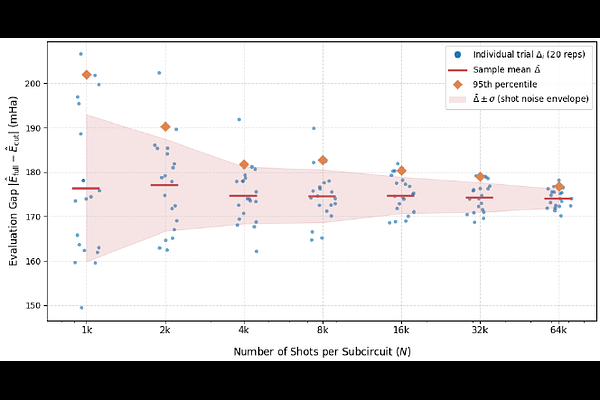
AbstractVariational Quantum Algorithms (VQAs) are a leading paradigm for near-term quantum computing, combining parameterized quantum circuits with classical optimization across quantum chemistry, combinatorial optimization, and quantum machine learning. Since real-world VQA deployments routinely require circuits that exceed available hardware capacity, quantum circuit cutting has become an indispensable execution strategy, and pre-trained parameters are increasingly distributed through public repositories, introducing supply-chain security risks that have received little attention. Prior quantum backdoor attacks either introduce detectable circuit modifications or depend on device-specific noise, and none consider circuit cutting as an attack surface. We present CutBackdoor, the first parameter-supply-chain backdoor that uses cut circuit execution from CutQC as the deployment-time trigger against VQAs. Under noisy finite-shot circuit-cut execution, poisoned parameters preserve full-circuit validation performance while substantially increasing cut-path reconstruction error, without any circuit modification. The trigger activates when a resource-limited victim responds to a qubit-capacity mismatch by invoking the cutting workflow, requiring no attacker presence at deployment. We provide a theoretical analysis and empirically validate it across varying shot budgets. Evaluation across multiple VQA benchmarks on IBM quantum backends demonstrates cut-path energy amplification of $1.3\times$ to $2.9\times$ \revA{over clean baselines on the VQE and VQD benchmarks while maintaining small stealthiness error on the full-circuit path. The cut-path gap persists across the evaluated backends and cut placements under matched compilation; Zero-Noise Extrapolation provides only partial mitigation, and the diagonal-cost QAOA benchmark delineates the attack's structural boundary