ZATT/ZNF451 promotes release of stalled TOP2 cleavage complexes

ZATT/ZNF451 promotes release of stalled TOP2 cleavage complexes
Leng, X.; Zarantonello, A.; Gadi, S. A.; Kakulidis, E.; Fey, P.; Ingham, A.; Hendiks, I. A.; Minocha, S.; Colding-Christensen, C.; Kristensen, S.; Willaume, S.; Palkova, N.; Gaubitz, C.; Garcia Lopez, A.; Bendix, P. M. M.; Sorensen, C. S.; Lund Nielsen, M.; Davey, N. E.; Mailand, N.; Miller, T.; Duxin, J. P.
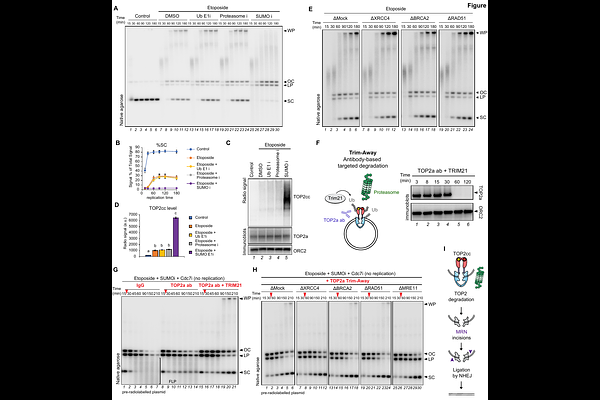
AbstractTopoisomerase II (TOP2) resolves DNA topological constraints through a tightly regulated cycle of DNA double-strand cleavage and religation. Nearby DNA damage or chemotherapeutic agents such as etoposide block the DNA religation step, stabilizing TOP2-DNA cleavage complexes (TOP2ccs) at DNA double-strand breaks (DSBs). The SUMO E3 ligase ZATT (ZNF451) has recently emerged as a key effector of TOP2cc repair, but its mechanism of action remains poorly understood. Here, we show that ZATT is sufficient to resolve TOP2ccs independently of TDP2, TOP2 proteolysis, and canonical DSB repair pathways. Using Xenopus egg extracts and biochemical reconstitution, we find that ZATT salvages trapped TOP2 by promoting TOP2 release from its stalled cleavage complex. Structural modeling and targeted mutagenesis in Xenopus egg extracts and human cells identify a highly conserved hydrophobic pocket in the tower domain of TOP2 where the ZATT coiled-coil hooks on to promote TOP2cc resolution. Our findings reveal a new strategy to resolve TOP2ccs that bypasses the exposure of dangerous DNA breaks.