UFMylation anchors splicing factors at the ER to reprogram nuclear splicing

UFMylation anchors splicing factors at the ER to reprogram nuclear splicing
Zhan, N.; Papareddy, R. K.; Bu, E.; Anisimova, A.; Perdigao, C.; Tirard-Thevenoud, M.; Mihailovic, M.; Akyol, H.; Karagoz, E.; Brose, N.; Irwin, N.; Dagdas, Y.
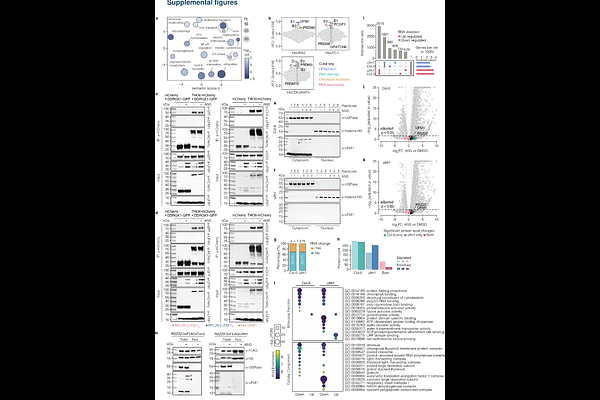
AbstractHow organelles communicate stress to the nucleus to coordinate adaptive responses remains a fundamental question in cell biology. Here, we identify a non-canonical retrograde signaling pathway in which stalling-induced UFMylation of ER-associated ribosomes anchors splicing regulators at the ER, directly coupling translational stress to nuclear RNA processing. Phylogenetic profiling linked the UFMylation machinery to a network of nuclear mRNA processing factors. Fractionation-based quantitative proteomics further supported this link and revealed that translational stress triggers UFM1-dependent retention of serine/arginine-rich (SR) splicing factors at the ER, depleting their nuclear pools. Mechanistically, UFMylated ribosomes physically tether SR proteins at the ER surface, driving widespread intron retention that preferentially targets transcripts encoding membrane lipid metabolism and endomembrane-associated processes, a response conserved from plants to mammals. These findings reframe UFMylation from a local ribosome repair signal to a systems-level coordinator of ER-nucleus communication that reprograms nuclear splicing and reshapes membrane-associated gene expression with implications for diverse human diseases linked to UFMylation defects.