Coherent-disorder-driven complexity transitions in a quantum-advantage architecture

Coherent-disorder-driven complexity transitions in a quantum-advantage architecture
Sung-Bin B. Lee, Chae-Yeun Park, Changhun Oh, Seung-Sup B. Lee
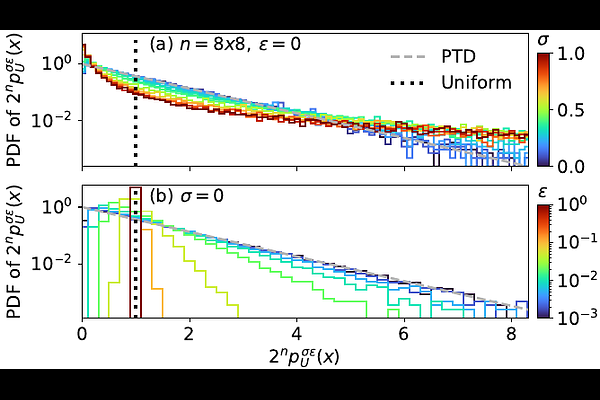
AbstractWhile decoherence is known to erode classical hardness in quantum random sampling, the impact of coherent spatial disorder remains an open question. We study a square-lattice instantaneous quantum polynomial-time (IQP) architecture subject to two-qubit gate-angle disorder and single-qubit dephasing using exact tensor-network simulations up to 576 qubits. For finite systems without dephasing, increasing disorder drives two consecutive crossovers toward classical simulability: the output distribution first loses anticoncentration, and then the tensor-network simulation cost drops from exponential to polynomial as entanglement is suppressed. The finite-size scaling collapses are consistent with continuous transitions in the large-system limit. Dephasing further reduces the complexity. We characterize the computationally hard regime through scaling laws that provide quantitative error-budget bounds for realistic near-term devices.