Direction of ESCRT-III-dependent membrane bending emerges from bilayer asymmetry

Direction of ESCRT-III-dependent membrane bending emerges from bilayer asymmetry
Tran, J.; Roux, A.
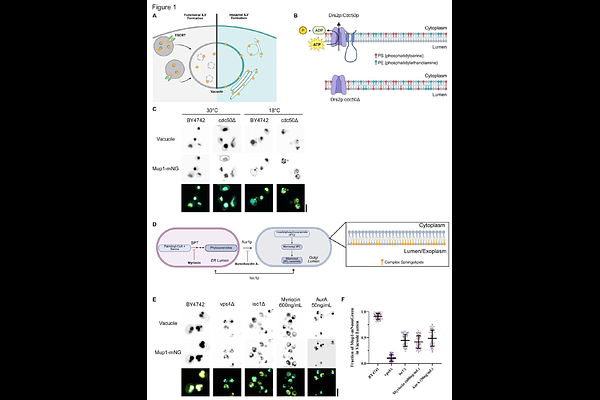
AbstractIn cells, ESCRT-III is unique in mediating fission of membrane necks from inside, a process called reverse-topology fission. Yet, in vitro, the complex primarily assembles outside membrane necks and mediates fission with normal topology. Here, we show that the direction of ESCRT-mediated membrane deformation emerges from bilayer asymmetry rather than being intrinsically encoded by the ESCRT machinery alone. Using genetic perturbations in budding yeast, we find that disruption of phospholipid asymmetry and sphingolipid homeostasis does not abolish ESCRT-dependent trafficking but renders ILV formation highly sensitive to membrane physical state, leading to inefficient cargo sorting and accumulation of stalled endosomal intermediates. In vitro reconstitution experiments and synthetic in vivo cargo systems demonstrate that asymmetric protein distribution across the membrane is sufficient to bias curvature directionality, with luminal leaflet crowding promoting efficient ILV incorporation and cytosolic crowding inhibiting inward budding. Together, these results support a model in which ESCRT-mediated membrane bending directionality emerges from the intrinsic tension difference between the bilayer leaflets. This tension difference arises from both lipid and cargo crowding-encoded asymmetries within the bilayer, rather than being solely encoded by ESCRT polymer properties.