The NANOGrav 15 yr and 20 yr Datasets: Timing Events and Pulse Shape Changes

The NANOGrav 15 yr and 20 yr Datasets: Timing Events and Pulse Shape Changes
Ben Jacobson-Bell, James M. Cordes, Shami Chatterjee, Sashabaw Niedbalski, Gabriella Agazie, Akash Anumarlapudi, Anne M. Archibald, Zaven Arzoumanian, Jeremy G. Baier, Paul T. Baker, Paul R. Brook, H. Thankful Cromartie, Kathryn Crowter, Megan E. DeCesar, Paul B. Demorest, Lankeswar Dey, Timothy Dolch, Elizabeth C. Ferrara, William Fiore, Emmanuel Fonseca, Gabriel E. Freedman, Nate Garver-Daniels, Peter A. Gentile, Joseph Glaser, Deborah C. Good, Jeffrey S. Hazboun, Ross J. Jennings, Megan L. Jones, David L. Kaplan, Matthew Kerr, Michael T. Lam, Bjorn Larsen, Duncan R. Lorimer, Georgia A. Lowes, Jing Luo, Ryan S. Lynch, Ashley Martsen, Alexander McEwen, Maura A. McLaughlin, Natasha McMann, Bradley W. Meyers, Patrick M. Meyers, Cherry Ng, Mason Ng, David J. Nice, Shania Nichols, Daniel J. Oliver, Timothy T. Pennucci, Benetge B. P. Perera, Nihan S. Pol, Henri A. Radovan, Scott M. Ransom, Paul S. Ray, Alexander Saffer, Ann Schmiedekamp, Carl Schmiedekamp, Brent J. Shapiro-Albert, Ingrid H. Stairs, Kevin Stovall, Abhimanyu Susobhanan, Joseph K. Swiggum, Mercedes S. Thompson, Amir Tresnjic, Haley M. Wahl
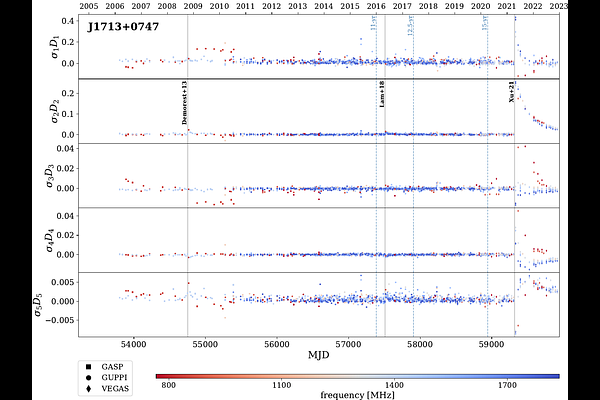
AbstractThe average pulse shape of a pulsar is typically stable over decadal timescales, enabling estimation of pulse times of arrival to better than a small fraction of the pulse width using matched filtering techniques. However, in North American Nanohertz Observatory for Gravitational Waves (NANOGrav) observations of PSR J1713+0747, three discrete timing events that depart from the prevailing timing model have been seen in the last 20 yr. All three correspond to morphological changes in pulse shape. Using principal component analysis, we analyze the pulse profiles of nine NANOGrav pulsars, including seven with profiles from the 15 yr dataset and two with additional profiles from the forthcoming 20 yr dataset. We recover the three known pulse shape change events in PSR J1713+0747 and another previously known event in PSR J1643$-$1224. We implement a ranking metric for candidate events and address four highly ranked candidates in this nine-pulsar sample. We also recover known slow pulse shape variations in PSR J1643$-$1224, PSR J1903+0327, and PSR B1937+21 and report an unexpected recurrence after ~10 yr of one such variation in PSR B1937+21.