Incorporating curved geometry in cosmological simulations

Incorporating curved geometry in cosmological simulations
Julian Adamek, Renan Boschetti
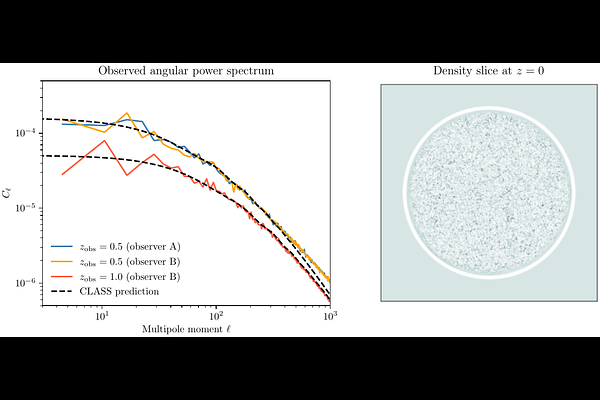
AbstractSpatial curvature is one of the fundamental cosmological parameters that is routinely constrained from observations. The forward modelling of observations, in particular of large-scale structure, often relies on large cosmological simulations. While the so-called separate universe approach allows one to account for the effect of curvature on the expansion rate in small sub-volumes, the non-Euclidean geometry is harder to accommodate. It becomes important when observables are computed over large distances, e.g. when photons travel to us from high redshift. Here we present a fully relativistic framework to run cosmological simulations for curved spatial geometry. The issue of consistent boundary conditions is solved by embedding a spherical cap of the curved spacetime into a hole within a flat exterior, where it can undergo free expansion. The geometric nature of gravity is made explicit in our framework, allowing for a consistent forward modelling of observables inside the curved patch. Our methodology would also work with any Newtonian code to a good approximation, requiring changes only to the initial conditions and post-processing.