Bidirectional Electron Transfer in Far-Red-Light Adapted Photosystem I. Implications for the Photosystem's Functionality

Bidirectional Electron Transfer in Far-Red-Light Adapted Photosystem I. Implications for the Photosystem's Functionality
Calcinoni, A.; Casazza, A. P.; Agostini, A.; Bortolus, M.; Carbonera, D.; Santabarbara, S.
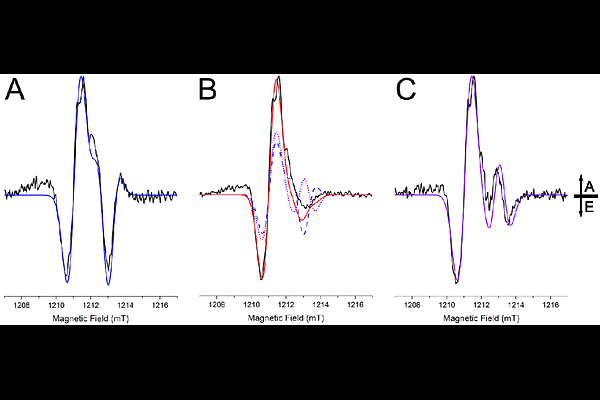
AbstractFar-Red (FR) Light Photoacclimation (FaRLiP) enables cyanobacteria to extend photosynthetic activity into the far-red region by extensively remodelling Photosystem I (PSI), including the replacement of several core subunits with paralogs that coordinate the red-shifted chlorophyll f (Chl f). The binding positions of Chls f are still a matter of debate, with the most recent structural findings supporting the location of a single Chl f molecule within the reaction centre (RC) at the so-called A-1B site. This was in turn suggested to strongly affect electron transfer (ET) directionality leading to an almost monodirectional transfer along the B branch in FR-PSI RC. Here, we directly probe ET in FR-PSI by characterising the photogenerated [P700A1-] spin-correlated radical pair using complementary pulse and Time-Resolved (TR) Electron Paramagnetic Resonance (EPR) spectroscopy at cryogenic temperature. Electron spin-echo decay kinetics are distinctly biexponential, indicating the formation of two charge-separated states. Consistently, out-of-phase ESEEM traces are quantitatively described by two modulation frequencies arising from different dipolar interactions, while TR-EPR spectra are accurately simulated by the combined contributions of [P700A1A-] and [P700A1B-] radical pairs. These results provide direct spectroscopic evidence that both the A and B branches remain photochemically active in FR-PSI. The conservation of bidirectional ET, even when considering the presence of a single Chl f molecule in the RC, further implies that the two radical pairs originate from a common primary electron donor. This finding identifies P700 as the most likely primary donor and argues against a mechanism in which the RC Chl f initiates charge separation.