The Impact of the Magnetised Cosmic Web on Ultra High Energy Cosmic Ray Propagation

The Impact of the Magnetised Cosmic Web on Ultra High Energy Cosmic Ray Propagation
Allegra Firinu, Franco Vazza, Carmelo Evoli
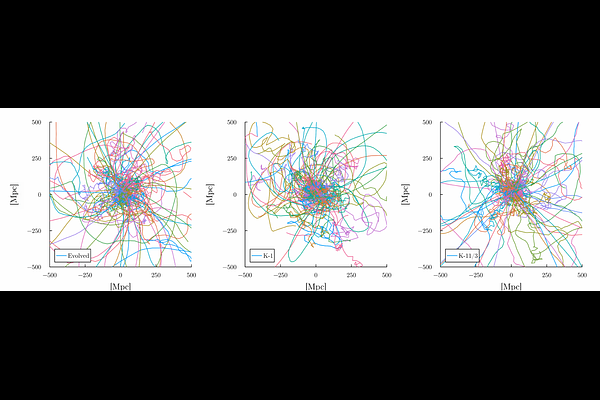
AbstractThe origin of ultra-high-energy cosmic rays (UHECRs) remains an open question. Extragalactic magnetic fields can modify their propagation and, at sufficiently low energies, suppress the observed flux through the magnetic horizon (MH) effect.} {We quantify the impact of the MH on the propagation of UHECR protons using cosmological simulations and a dedicated numerical framework that follows cosmic rays in a time-evolving background.} {We use \texttt{UMAREL}, a parallel code developed for this study, to propagate UHECR protons through a cosmological volume simulated with ENZO. The magnetic-field configurations are chosen to be consistent with recent radio constraints on magnetic fields in cosmic-web filaments. Unlike stationary approaches, we follow particle trajectories through a sequence of time-evolving snapshots and compare the resulting arrival properties with those in an unmagnetised reference model.} {We find that observationally motivated extragalactic magnetic fields progressively suppress the flux of arriving protons below \(E \lesssim 3 \times 10^{19}\,\mathrm{eV}\) through an effective Magnetic Horizon (MH). We estimate \(R_{\mathrm{MH}} \sim 50\,\mathrm{Mpc}\) for protons with \(E = 10^{18}\,\mathrm{eV}\) and \(R_{\mathrm{MH}} \sim 150\,\mathrm{Mpc}\) for protons with \(E = 10^{19}\,\mathrm{eV}\).} {The MH generated by extragalactic magnetic fields must be taken into account when modelling UHECR propagation and interpreting the spectrum observed in the local Universe.}