Evidence for Millihertz Oscillations in the bright atoll source GX 3+1

Evidence for Millihertz Oscillations in the bright atoll source GX 3+1
Malu Sudha, Renee M. Ludlam, Diego Altamirano, Edward M. Cackett, Mason Ng
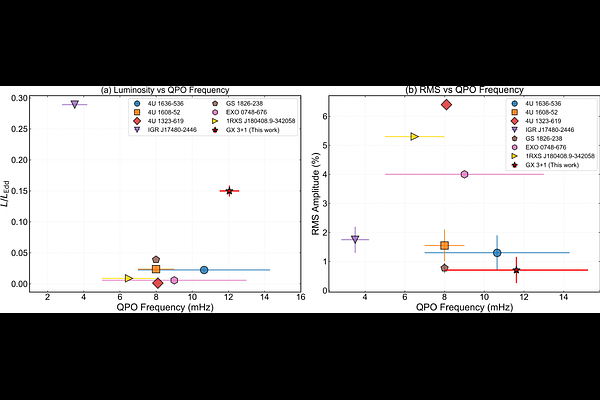
AbstractWe report evidence for millihertz (mHz) QPOs in the bright atoll neutron star low-mass X-ray binary (NS LMXB) source GX 3+1 using NICER in the 0.5--10 keV energy band. Across 7 observational datasets obtained over 6 days, we made 8 candidate mHz QPO detections with local significance above 95%, one of which remains above 95% global significance after the trial correction. These mHz QPOs were detected in the 7--15 mHz frequency range and had fractional rms amplitudes ranging from 0.51--1.41%. Our studies indicate no association between the hardness intensity diagram location of the candidate QPOs and their rms amplitudes. There appears to be a monotonous increase in rms with energy, except in some observations where there is a pivot around 3--4 keV or at ~ 5 keV. Previous studies of mHz QPOs in other sources in literature indicate a pivot around 3 keV in the rms-energy relation, but in our study some tentative detections suggest a pivot at around ~ 5 keV, though the large uncertainties in most cases prevent a robust statistical claim. Although properties such as the frequency range of detection and fractional rms amplitudes of the mHz QPOs in our study are well in agreement with that in literature for other NS LMXBs, the luminosity at which these candidate QPOs occur are higher than that of other sources. The rms-energy relation of the candidate mHz QPOs and the luminosity at which they occur challenges some of the existing considerations of mHz QPO origin.