A novel AR molecular glue degrader via bivalent engagement of the N-terminal domain and RNF213-UBE2J2 complex

A novel AR molecular glue degrader via bivalent engagement of the N-terminal domain and RNF213-UBE2J2 complex
Wu, K.; Wu, Q.; Lu, Y.; Yang, Q.; Ran, T.; Zhang, J.; Qiu, X.; Huang, C.; Lin, Y.; Chen, J.; Yang, Z.; Zhang, J.; Qin, W.; Liu, Z.; Liu, X.; Tang, M.; Chen, H.; Zheng, J.; Chen, X.; Shang, J.
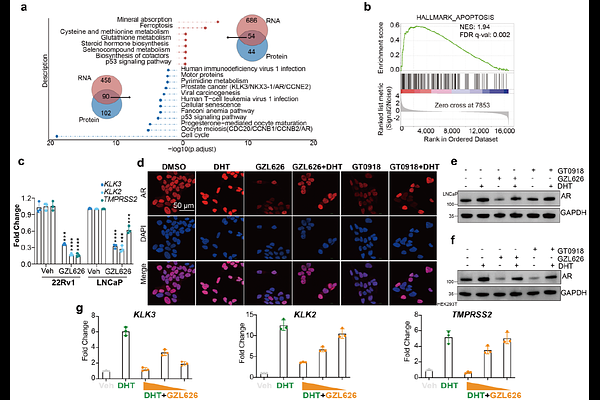
AbstractTargeted protein degradation enables the elimination of disease-relevant proteins through induced proximity between E3 ligases and substrates. Current androgen receptor (AR) therapies act via the ligand-binding domain (LBD) but fail against constitutively active LBD mutants or splice variants such as AR-V7. Here, we identify GZL626, a small-molecule degrader that induces proteasome-dependent degradation of both full-length AR and AR-V7. GZL626 suppresses AR transcriptional activity, inhibits proliferation of AR-positive prostate cancer cells, and blocks SARS-CoV-2 infection. Mechanistically, GZL626 binds the intrinsically disordered AR N-terminal domain (NTD) and promotes formation of a noncanonical RNF213-UBE2J2-AR ternary complex that drives AR ubiquitination and degradation. The AR DNA-binding domain (DBD) acts as a structural hub within this assembly. Distinct from PROTACs or classical molecular glues, GZL626 engages both AR and RNF213 bivalently, remodeling protein interactions to stabilize a functional E3-E2-substrate complex. These findings establish GZL626 as a first-in-class NTD degrader with potential to overcome resistance in advanced prostate cancer.