Binary Black Hole Puncture Initial Data with Physics-Informed Neural Networks

Binary Black Hole Puncture Initial Data with Physics-Informed Neural Networks
Thiago Assumpção, Ignacio Brevis, Irene Pitsiladi, Martin Zinzen, Miguel Bezares
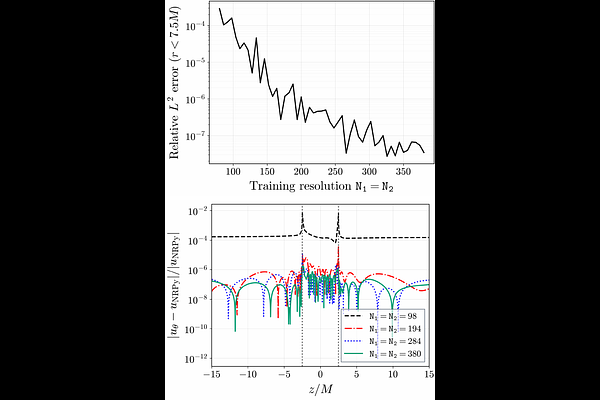
AbstractWe present Pinndorama, a physics-informed neural network (PINN) code for solving the Hamiltonian constraint in the puncture formalism. The networks are trained solely on the governing equation and boundary conditions, without an analytical or perturbative guiding solution, with collocation points sampled in curvilinear coordinates. Training combines two optimization algorithms: an initial stage using adaptive moment estimation (Adam), followed by the self-scaled Broyden quasi-Newton method. We apply this approach to a spherically symmetric test problem with a known exact solution, axisymmetric binary punctures with unequal spins, and a fully three-dimensional GW150914-like configuration with unequal spins and orbital momenta. Comparisons with the NRPyElliptic solver yield relative $L^2$ errors of order $10^{-8}$ in axisymmetry and $10^{-5}$ in three dimensions. In addition, we reduce the hyperbolic-relaxation time in NRPyElliptic by a factor of approximately $4.6$ by training a parametric network that takes the puncture spin as input and provides a physics-informed initial guess to the solver. These results demonstrate that PINNs can provide accurate binary-puncture initial data and complement conventional elliptic solvers in numerical relativity.