Molecular Mechanism of Lipid Recognition and Membrane-Guided Gating in Plant Minimal START Proteins

Molecular Mechanism of Lipid Recognition and Membrane-Guided Gating in Plant Minimal START Proteins
Kumari, K.; Mahtha, S. K.; Parihar, M.; Tiwari, G.; Yadav, G.; Gaur, V.
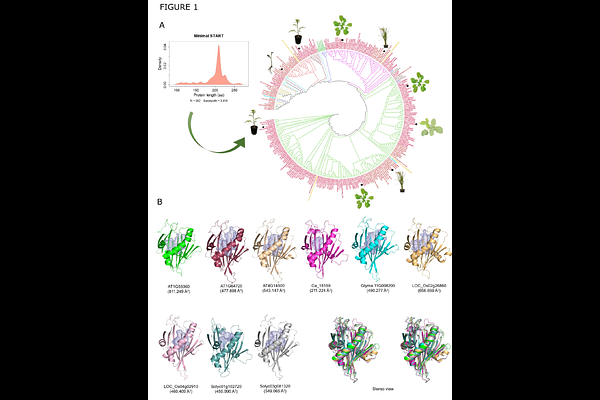
AbstractThe hydrophobic nature of lipids requires specialized transport mechanisms, and one such non-vesicular transport mechanism involves START (StAR-related lipid transfer) domain proteins. START domains either occur as a part of multidomain proteins or occur solo as in minimal START proteins. Unlike well-studied multidomain variants, plant minimal START proteins remain poorly understood, leaving their ligand specificity, structural dynamics, and biological roles largely uncharacterized. Integrating structural screening with experimental validation, we analyzed representative plant minimal START proteins and confirmed their specific binding to amphipathic lipids, primarily myristic acid and lysophosphatidylcholine. The ligand binding involves a bipartite mechanism, in which basic residues within the cavity interact with polar lipid headgroups, while the hydrophobic tails are accommodated deeper within the cavity. Mechanistically, ligand binding induced closure of a lid-like gate at the cavity entrance, whereas membrane proximity promoted reopening of the gate and ligand release, collectively suggesting a membrane-guided gating mechanism for lipid exchange. Consistent with this model, localization studies show that these proteins associate with the endoplasmic reticulum, plastids, Golgi apparatus, and plasma membrane, major sites of lipid metabolism. Together, our findings establish plant minimal START proteins as bona fide lipid-binding proteins that utilize a bipartite ligand-binding mechanism coupled with membrane-responsive gating dynamics.