Deoxyribonucleotide incorporation reshapes mRNA design beyond canonical ribonucleotide boundaries

Deoxyribonucleotide incorporation reshapes mRNA design beyond canonical ribonucleotide boundaries
Ding, X.; Liao, R.; Bampi, G. B.; Zhang, D.; Guan, S.; Rosenecker, J.
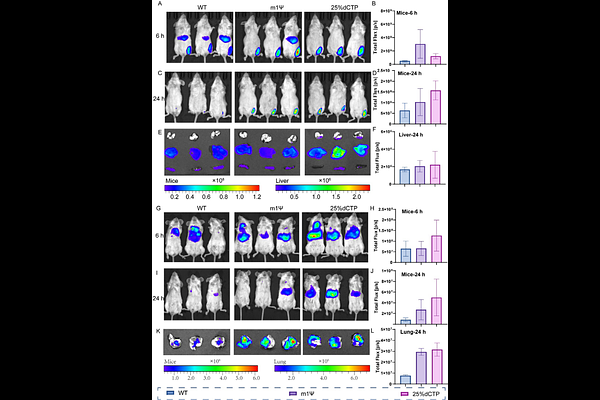
AbstractMessenger RNA (mRNA) is canonically composed of ribonucleotides, with sporadic incorporation of deoxyribonucleotides into natural RNA transcripts being traditionally regarded as a rare, deleterious error arising from transcriptional infidelity. Here, we challenge this paradigm by demonstrating controlled partial substitution of ribonucleotides with deoxyribonucleotides during in vitro transcription (IVT) generates intact, stable and fully translationally competent IVT-mRNA. Unexpectedly, chimeric DNA-RNA backbone modification exhibits markedly enhanced IVT-mRNA translation several fold across multiple cell types and in vivo via diverse dosing routes relative to their ribonucleotide-based counterparts. 25% substitution of cytidine triphosphate with deoxycytidine triphosphate achieved best-performing translational output, surpassing the current gold-standard N1-methylpseudouridine (m1{Psi})-modified IVT-mRNA in a B16-OVA tumor vaccination model. These findings identify nucleotide class composition as a previously unrecognized parameter governing IVT-mRNA function and establish hybrid ribonucleotide-deoxyribonucleotide backbone engineering as a versatile strategy to expand the chemical space for next-generation mRNA therapeutics.