Quantitative Comparison of 3D-1D Vascular Coupling Models: Lateral Average versus Sphere of Influence Methods

Quantitative Comparison of 3D-1D Vascular Coupling Models: Lateral Average versus Sphere of Influence Methods
Amare, R.; Vargun, D.; Zhang, P.; Parrish, S.; Stolley, D.; Santos, C.; Jacobsen, M.; Cressman, E.; Riviere, B.; Fuentes, D.
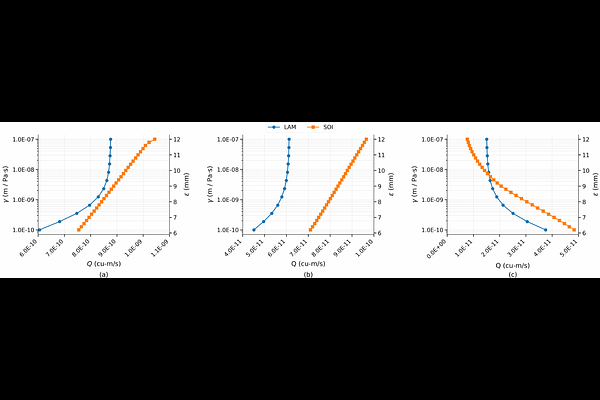
AbstractComputational models coupling one-dimensional vascular networks with three-dimensional tissue domains are widely used for predicting blood flow distribution in tumor perfusion, drug delivery, and therapeutic planning. Two prominent coupling paradigms have emerged: the Lateral Average Model (LAM), which implements distributed transmural exchange via a vessel wall conductivity parameter {gamma} [m.Pa-1.s-1], and the Sphere of Influence (SOI) model, which employs localized terminal coupling via a source sphere radius {epsilon} (m). Despite their broad application, systematic quantitative comparisons of their parametric behavior and predictive equivalence remain lacking. We compare LAM and SOI in 3D-1D simulations on a benchmark vascular network and a porcine liver study with a hepatic arterial network reconstructed from CT arteriography Across a benchmark vascular network under three sink configurations, the LAM net flow rate rose smoothly with {gamma} and saturated at a plateau, while the SOI net flow rate increased with {epsilon} without saturating; as a result, global-flow equivalence between the two formulations exists only for particular boundary geometries, and not at all within the tested parameter range for one of the three configurations examined. Despite this partial agreement in total flow, the two models diverged substantially in regional perfusion: in a porcine hepatic arterial network reconstructed from CT arteriography, SOI predicted stable perfusion fractions to two regions of interest across its full tested parameter range, whereas LAM predictions for the same regions varied several-fold with vessel wall permeability and, at low permeability, could invert which region received more flow. These results indicate that the choice of coupling model has limited consequence for predicted total organ flow but substantial consequence for predicted local drug delivery, and we provide guidance for selecting between the two formulations depending on the clinical or research question being asked.