Demonstrating and Benchmarking Classical Shadows for Lindblad Tomography

Demonstrating and Benchmarking Classical Shadows for Lindblad Tomography
Rune Thinggaard Birke, Johann Bock Severin, Malthe A. Marciniak, Emil Hogedal, Andreas Nylander, Irshad Ahmad, Amr Osman, Janka Biznárová, Marcus Rommel, Anita Fadavi Roudsari, Jonas Bylander, Giovanna Tancredi, Daniel Stilck França, Albert Werner, Christopher W. Warren, Jacob Hastrup, Svend Krøjer, Morten Kjaergaard
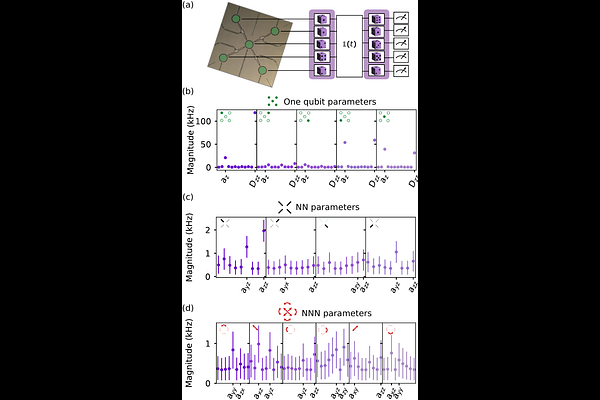
AbstractSpurious couplings and decoherence degrade the performance of solid-state quantum processors, demanding careful design, calibration, and mitigation protocols. These strategies often rely on characterization of the idling processor, but tomographic recovery of (time-independent) Lindblad dynamics scales exponentially with qubit count. Here, we experimentally benchmark and demonstrate that randomized ("shadow") measurements accelerate Lindblad tomography on a superconducting transmon processor. We first implement extensible Lindblad tomography, which estimates Lindblad parameters using a complete tomographic dataset, and use it as a baseline to benchmark a shadow tomography approach, shadow Lindblad tomography. The shadow approach recycles randomized configurations to estimate the same Lindblad parameters using far fewer resources under physically motivated locality assumptions. We experimentally verify these assumptions in our processor by implementing the protocols on one- and three-qubit subsystems; here, shadow Lindblad tomography reproduces extensible Lindblad tomography within uncertainties while using exponentially fewer configurations. Leveraging this efficiency, we apply shadow Lindblad tomography to the full five-qubit processor and recover all single qubit dissipation and two-qubit coupling parameters in 9 hours of acquisition time compared to an estimated 58 hours for extensible Lindblad tomography. Additionally, our shadow implementation is compatible with conventional Gaussian error propagation, avoiding the use of median-of-means estimators. Together, these results demonstrate how randomized shadow tomography protocols can be practically implemented to learn quantum processor dynamics at an increasing qubit count.