Expanding the palette of trehalose-based fluorophores for live mycobacterial detection

Expanding the palette of trehalose-based fluorophores for live mycobacterial detection
Brodeth, A.; Dosanjh, R.; Schwartz, L. A.; Kramer, S.; Goggins, S.; Cresser-Brown, J.; Zigli, A.; Swarts, B. M.; Kamariza, M.
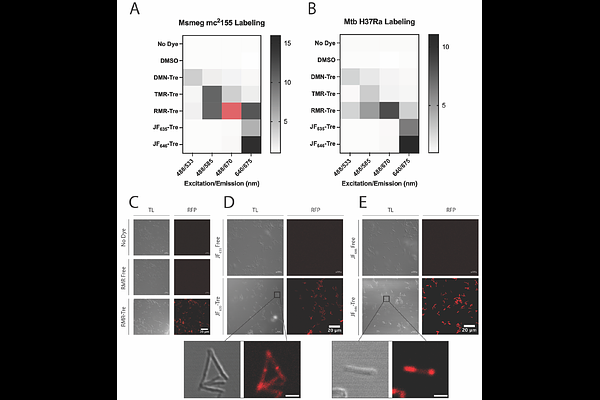
AbstractTuberculosis (TB) remains the world's leading infectious cause of death. Trehalose-based fluorogenic probes have emerged as powerful tools for labeling and studying mycobacteria, including Mycobacterium tuberculosis (Mtb), the causative agent of tuberculosis. However, existing probes occupy a limited spectral range and require compromise between brightness, specificity, and functional readouts. Here, we report the design and characterization of two trehalose conjugates derived from Janelia Fluor(R) dyes, JF635-Tre and JF646-Tre, which extend the trehalose-based platform into the far-red region. Following NHS ester-mediated synthesis, the trehalose-conjugated analogs displayed strong far-red fluorescence, with excitation/emission maxima at 638/654 nm and 648/663 nm for JF635-Tre and JF646-Tre, respectively. Both probes exhibited concentration- and time-dependent labeling of Mycobacterium smegmatis (Msmeg) and Mtb with minimal background fluorescence from the corresponding unconjugated dyes. Furthermore, we observed reduced labeling in heat-killed cells compared to live Msmeg, particularly for JF646-Tre, consistent with sensitivity to metabolic activity. Both JF-Tre derivatives produced significant cellular labeling and JF635-Tre distinguished untreated from INH-treated samples in drug susceptible Mtb, demonstrating the potential of the JF-Tre probes to report on INH susceptibility and resistance. Together, these findings expand the toolkit of trehalose-based probes and highlight how fluorophore identity influences probe performance in mycobacterial fluorescence imaging and drug susceptibility testing.