Asymmetric Structural Transfer Between Natural Language and Biological Foundation Models

Asymmetric Structural Transfer Between Natural Language and Biological Foundation Models
Wang, L.
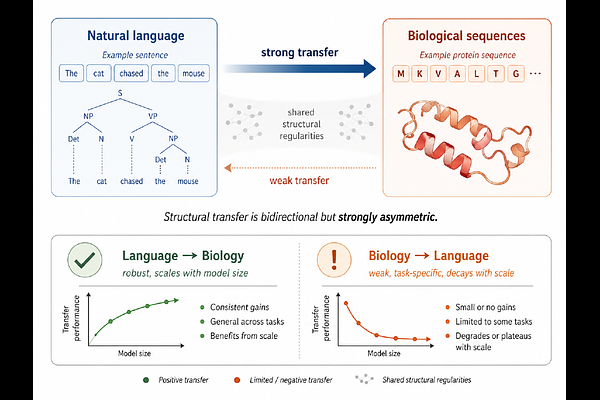
AbstractCross-domain transfer is a defining property of foundation models, yet whether such transfer is symmetric across domains remains unknown. Prior work has reported a striking transfer from natural language to biological sequences: language models fine-tuned only on English structural tasks acquire zero-shot protein-homology discrimination. Here we ask the converse and general question is structural transfer between language and biology directional and answer it systematically. We first reproduce forward transfer (language to biology) under controlled conditions, then evaluate the reverse direction (biology to language) across fine-tuning, iso-token continued pretraining, model scaling, multiple biological foundation-model families (ESM-2, ProtBERT), and adversarial synthetic structure tasks. Reverse transfer is consistently weak: it does not exceed matched-token controls, does not scale, and does not generalize. In an architecture-matched 2x2 analysis on models with known training data, which eliminates the pretraining-contamination confound that clouds large-model studies, a language model retains far more competence when moved to biology (off-domain drop 0.08) than a biological model retains when moved to language (drop 0.36). Scaling widens rather than closes this gap: language to biology transfer strengthens with size while biology to language transfer decays toward chance, a pattern shared by two independent protein-model families. Our findings establish that shared structural regularities between natural language and biological sequences do not imply symmetric representational transfer, revealing an intrinsic directionality in cross-domain foundation-model learning.