The average X-ray spectrum of the volume-complete M-, F-, G-, and K-type star sample within 10 pc of the Sun

The average X-ray spectrum of the volume-complete M-, F-, G-, and K-type star sample within 10 pc of the Sun
Xueying Zheng, Gabriele Ponti, Nicola Locatelli, Beate Stelzer, Enza Magaudda, Konrad Dennerl, Michael Freyberg, Jeremy Sanders, Marilena Caramazza, Manami Sasaki, Andrea Merloni, Jan Robrade, Teng Liu, He-shou Zhang, Martin G. F. Mayer, Yi Zhang, Michael C. H. Yeung, Werner Becker
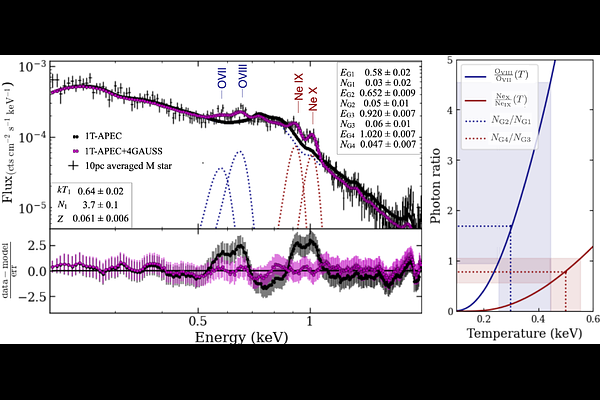
AbstractF, G, K and M type stars are the most abundant stellar population in the Milky Way and are expected to contribute to its diffuse X-ray emission. Yet their intrinsic average X-ray spectrum remains poorly constrained due to their faint X-ray luminosities, leaving their collective role in the X-ray background of the Milky Way uncertain. We analysed the volume-complete sample of M- (M0--M6) and FGK-type stars within 10 pc of the Sun using data from eROSITA all-sky survey aboard the Spectrum-Roentgen-Gamma (SRG) mission (eRASS:4). Individual spectra were normalized by exposure and distance and stacked to produce representative averages. The distance-normalized emission measures yield an average X-ray luminosity of $(2.6 \pm0.1)\times 10^{27}$ erg/s for M-type stars, and $(15\pm3)\times 10^{27}$ erg/s for F, G and K-type stars in 0.2--2.0 keV. The average spectra could be well described by a sum of three and two thermal models. Fitted temperatures and abundances remain consistent across M-star subgroups, while early-M stars are surprisingly on average less luminous than mid/late-M types. These results offer new insights into the collective X-ray properties of nearby stars, and provide motivation to explore the link with the unresolved soft X-ray background of the Galaxy.