From Hummingbird to Elephant: Amyloid Formation in Natural Transthyretin Variants

From Hummingbird to Elephant: Amyloid Formation in Natural Transthyretin Variants
Ritsch, I.; Scholl, D.; Rafiq, M.; Martinez-Yamout, M. A.; Lander, G. C.; Dyson, H. J.; Wright, P. E.
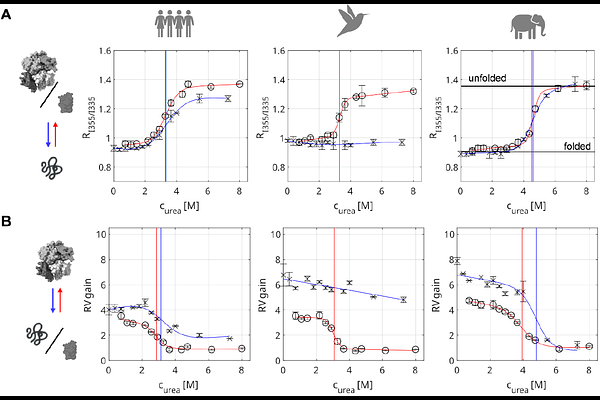
AbstractTransthyretin (TTR) is a secreted protein associated with cardiac and other amyloid diseases via misfolding. We have previously shown that agitation of human TTR solutions at neutral pH results in aggregation and fibril formation. Here we report that agitation-induced aggregation of TTR from species with very different heart rates (Anna's hummingbird, hbTTR, and African elephant, aeTTR) differs from that of human TTR (huTTR). Aggregation of hbTTR is slow and favors formation of smaller, fibrillar aggregates, while aeTTR aggregation is rapid and favors larger, more amorphous particles. Spherical, early-stage oligomeric intermediates were found for all variants by mass photometry and electron microscopy. The slow aggregation of hbTTR matches its resistance to denaturation by 8 M urea. The widely different aggregation behavior exhibited by these naturally occurring TTR variants in response to mechanical agitation under close to physiological conditions provides insight into how small sequence differences can contribute to the evolutionary fitness of different animals.